
When a motorcycle part appears wrong or damaged after delivery, “the parts are defective” rarely gives a supplier enough information to review the problem. Start with an evidence package that identifies the order and product, preserves the original condition, defines the scope and separates observations from possible causes.
This motorcycle parts defect claim checklist is for importers, distributors, inspectors and private-label buyers. It covers supplier-quality documentation, not legal, insurance or personal-injury claims. Photographs and records can support review, but they do not prove root cause, responsibility or a commercial outcome.
Quick Answer: What Evidence Should a Defect Claim Include?
A reviewable report should include:
- purchase order or order reference;
- product name, SKU and approved drawing, sample or revision;
- carton label, batch reference or other available production identifier;
- total quantity received, quantity checked and quantity showing the reported condition;
- a neutral description of what was observed and when it was found;
- overview, detail and context photographs;
- model, model year or version information when fitment is involved;
- hardware, packaging and shipping-condition evidence when relevant; and
- the immediate action requested, such as clarification or technical review.
XCMOTOPARTS’ public After-Sales Response guidance starts with photos, model details, order records, the carton label and batch information. Sending these references together helps connect the observation to the correct product and supply record.
Preserve the Product, Packaging and Original Condition
Separate the affected part from saleable inventory and retain its hardware bag, inner protection, outer carton and label. Do not clean, repair, repaint or discard it before documenting its received condition. If parts from different cartons were mixed, record that limitation rather than presenting an uncertain carton assignment as fact.
Photograph the packaging arrangement before changing it. Show the product-packaging relationship, reported area, label and hardware. The Motorcycle Parts Packaging Checklist explains how packaging layers, hardware control and receiving evidence fit into wholesale-order review.
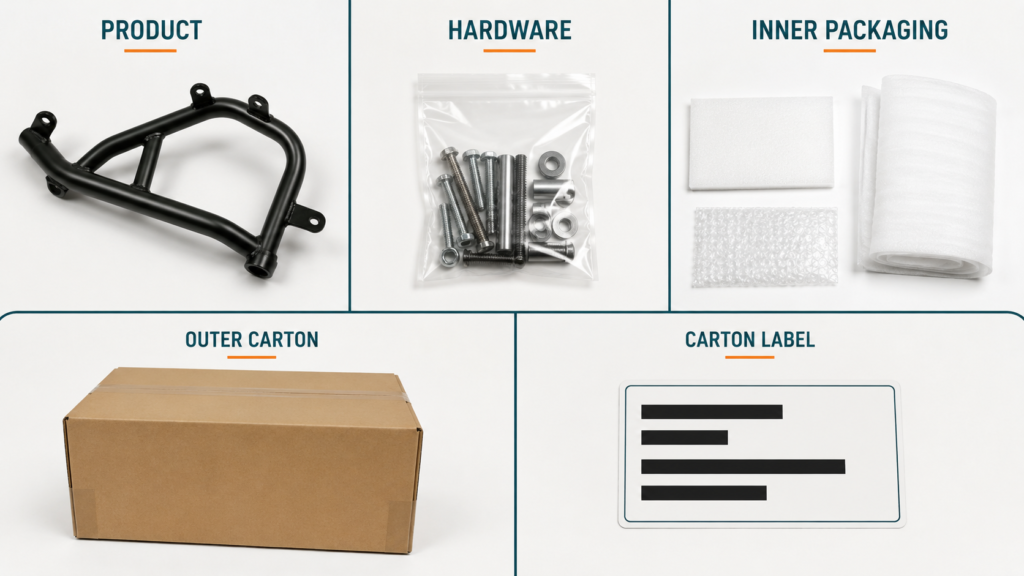
Identify the Order, Product, Revision, Carton and Batch
A product name alone may not isolate the supplied version. Record the order number, SKU, product description, approved revision or sample reference, and any model-version details supplied with the order. Photograph the carton label clearly, with private customer data redacted only in copies intended for wider circulation.
Keep each carton or batch reference connected to the units inspected from it. This matters when only one carton, shipment section or product version appears involved. For more background on version control and scope, see Motorcycle Parts Batch Consistency.
Describe the Observed Condition Without Assigning Cause
Write what can be seen or measured: “the left mounting hole does not align during this installation check,” “the coating has a visible raised area,” or “the sealed hardware bag contains fewer pieces than the approved list.” Avoid jumping from an observation to “manufacturing defect,” “shipping damage” or “wrong model” before the supporting references have been compared.
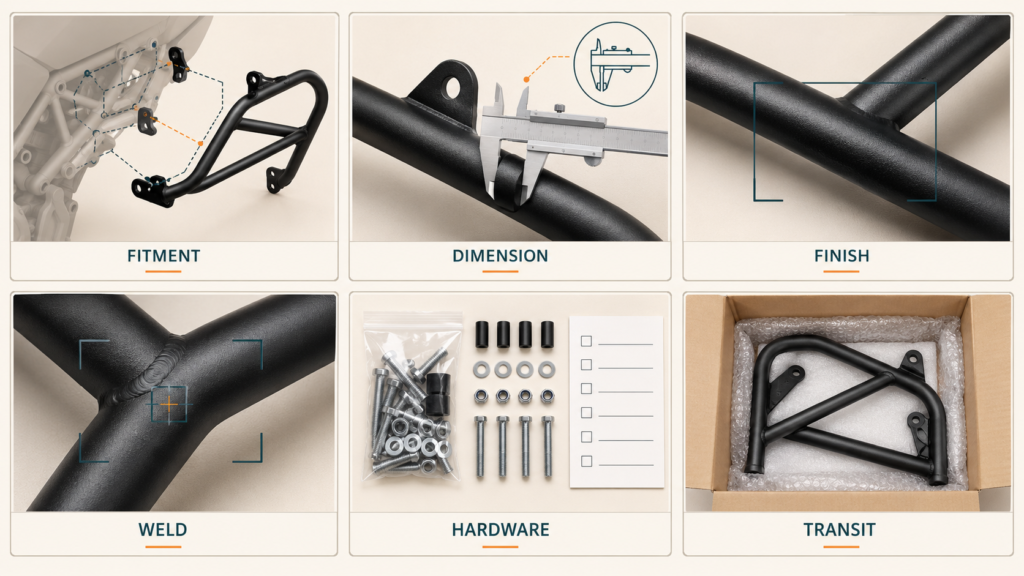
Also state when and where the condition was found: at receiving, during unpacking, during pre-installation inspection or during a controlled fitment check. XCMOTOPARTS publicly lists model version, production dimension, welding position, surface finish, missing hardware and packing damage as possible review directions. Those categories organize the evidence; they are not advance conclusions.
Match the Evidence to the Type of Claim
Different observations need different views. Add the relevant quantity scope to every report.
| Claim type | Minimum identification | Useful visual evidence | Additional context | What the evidence cannot prove |
|---|---|---|---|---|
| Fitment or model-version mismatch | Order, SKU and approved application | Installation area, mounting points and part orientation | Motorcycle model, year/version and application | A close-up may hide orientation or version differences |
| Dimension or hole-position concern | Order, SKU and drawing revision | Overview plus measurement-tool placement | Drawing datum and measurement method | A photograph of a reading may not validate the method |
| Weld or structural-condition concern | Order, SKU and exact location | Overall part and focused views from multiple angles | Whether use or installation stopped | Photos cannot establish structural suitability or root cause |
| Surface-finish damage | Order, SKU and carton reference | Neutral-light overview and close-up | Packaging contact points and unpacking condition | Lighting can exaggerate or conceal appearance |
| Missing or incorrect hardware | Order, SKU and hardware list | Sealed bag, laid-out contents and package label | Units and bags checked | Loose hardware without its original bag loses context |
| Label or SKU mismatch | Order line and approved SKU | Product and carton labels in connected views | Product identity inside the carton | A label alone may not identify the enclosed product |
| Carton or transit damage | Order and carton reference | Carton faces, inner protection and product position | Receiving condition and carrier records | Photographs alone do not assign responsibility |
For surface and hardware examples, review Surface Peeling or Damage and Missing Hardware. XCMOTOPARTS notes that a hardware bag can be checked against its checklist and that packing photos may support the shipment record.
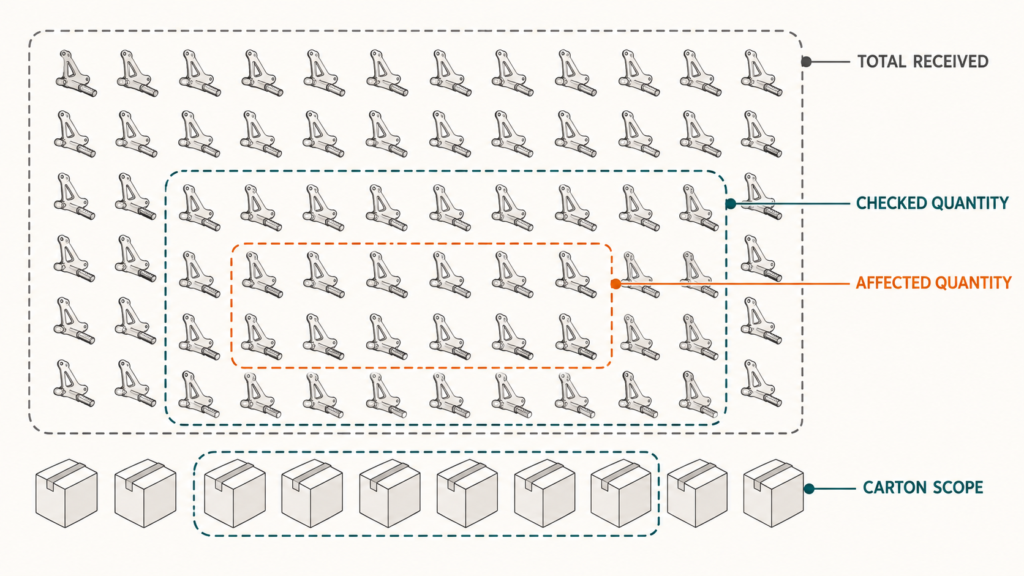
Report the Inspected, Affected and Total Quantities
“Several pieces have a problem” has no denominator. Report the total received quantity, how many units were actually checked, how many of those showed the same observation and which cartons they came from. If the inspection was a sample rather than a full check, say so.
Do not extrapolate a batch-wide defect rate from a few examples. Keep unaffected comparison units available where practical, because a same-order comparison can help clarify whether the observation is isolated, repeated or associated with a particular carton or version.
Compare the Claim with the Approved Product Reference
Use the commercial and technical reference that governed the order: the approved drawing, specification, sample, packaging instruction, label artwork or hardware list. Mark the exact feature being compared. If no approved tolerance or visual standard exists, describe the difference without inventing one.
The Motorcycle Parts Quality Inspection Checklist provides related context for connecting inspections to approved requirements. The goal at the claim stage is to show what reference was used, not to recreate the entire pre-shipment inspection.
Separate Product, Fitment, Hardware and Transit Questions
One delivery can contain more than one issue. Create separate lines for a fitment concern, a missing fastener, a surface observation and a damaged carton. Give each line its own quantities and evidence references. This prevents an outer-carton condition from being treated automatically as the cause of a product observation, or an installation difficulty from being treated automatically as proof that the supplied part is incorrect.
Use consistent filenames such as the order reference, carton reference, unit number and view type. A simple evidence index is easier to review than a message thread containing unlabelled photos.
Decide When Photos Are Not Enough
Photographs may not show scale, measurement technique, internal condition, dynamic fitment or loading. The next review step may require a clearer measurement view, video, an unaffected comparison, a controlled installation check or physical-part review. Which step is appropriate depends on the observation and the available references.
If a reported condition could affect safe installation or structural use, stop installation, use or distribution of the relevant units and escalate for qualified technical review. Do not rely on a remote photograph to declare the part safe, failed or suitable for continued use.
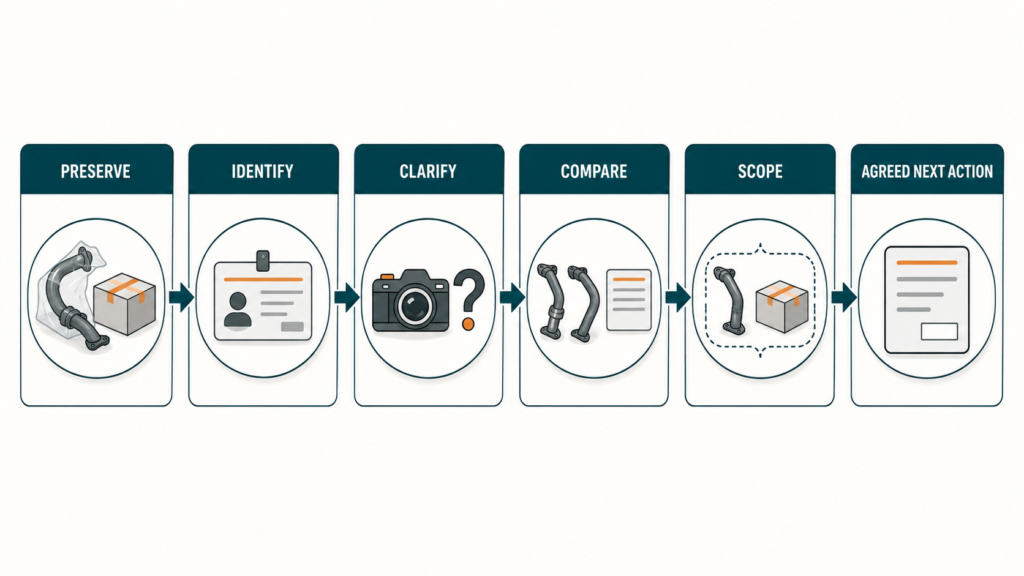
Decision Path: Contain, Clarify, Review or Escalate
- Contain: separate the relevant units and preserve products, hardware, packaging and labels.
- Identify: connect each observation to the order, SKU, approved revision, model version, carton or batch reference.
- Clarify: describe the condition neutrally and request missing overview, detail, measurement, fitment or packaging context.
- Review: compare the observation with the approved product reference and available records.
- Scope: define the checked, affected, total and carton quantities without unsupported extrapolation.
- Escalate or agree the next action: document the appropriate technical or commercial review step without treating an early observation as a final cause or liability decision.
Frequently Asked Questions
What should a buyer include in a motorcycle-parts defect claim?
Include the order, product and approved revision; model details when relevant; carton or batch references; inspected and affected quantities; a neutral description; clear photographs; packaging or hardware evidence; and the requested next review action.
How many photos are needed for a supplier quality claim?
There is no universal number. Send enough to identify the product and label, show the whole context, document the reported area from useful angles and connect it to fitment, measurement, hardware or packaging evidence.
Can photographs prove the root cause of a motorcycle-parts defect?
No. Photographs can document visible condition and guide review, but they do not automatically prove a defect, root cause, liability or the correct disposition.
Should affected parts or packaging be discarded before the supplier responds?
Generally, preserve the relevant part, hardware, labels and packaging while the issue is being documented and reviewed. Record any material that was already discarded or altered as a limitation.
How can a buyer separate transit damage from a product defect?
Document all carton faces, inner protection, product position and the condition at unpacking, then compare the product observation with the packaging contact points and available shipment records. This evidence supports review but does not by itself assign responsibility.
What if only some cartons or units appear to be affected?
Keep carton identities separate, state how many units were checked in each relevant carton and retain unaffected comparisons. Do not apply a small sample result to the entire delivery without further evidence.
Send a Reviewable Defect Claim
A useful motorcycle parts quality claim is specific, traceable and neutral. Preserve the evidence, identify the supplied version, separate issue types and define the quantity scope before asking for a conclusion. For an existing XCMOTOPARTS order, contact the person handling that order and provide the references available to you. For a new B2B sourcing inquiry, use the Contact / Quote page.