
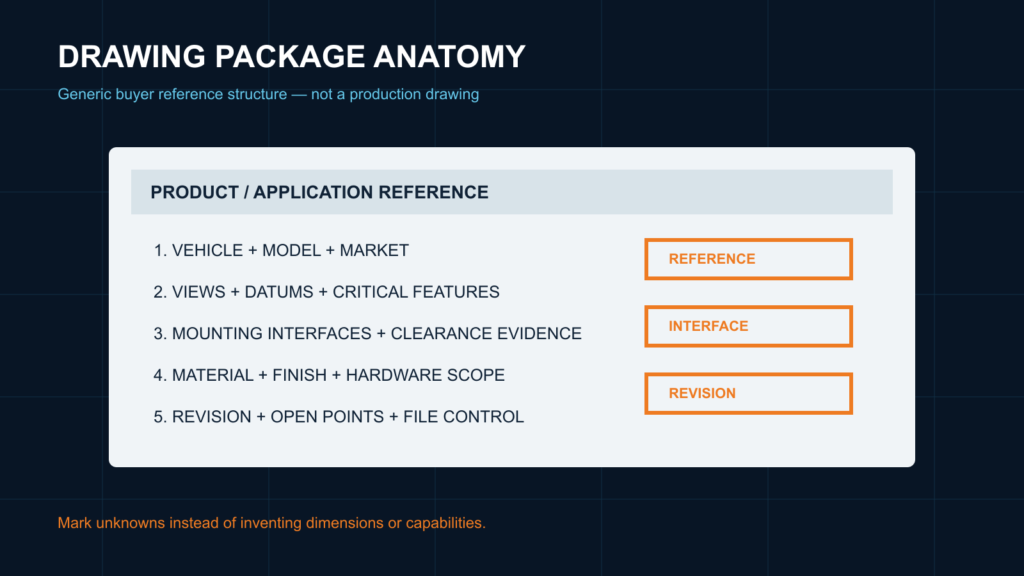
A clear motorcycle parts drawing package helps a supplier understand the application, review fitment risks and prepare a quotation based on the same reference. For model-specific rear racks, crash bars, engine guards and three-wheeler metal parts, the package does not need to be complicated. It does need to identify what is known, what is still open and which file or sample controls the request.
Before requesting a quotation, send the vehicle or application reference, the current drawing or sample, important views and dimensions, mounting-interface evidence, material and finish requirements, packaging assumptions and a clear revision identifier. If information is not final, mark it as open instead of guessing. Ask the supplier to list any quotation assumptions before comparing prices.
Why a Drawing Package Improves Quotation Quality
A product name alone rarely defines the complete scope of a motorcycle metal part. “Rear rack” may refer to different mounting positions, luggage platforms, tube layouts or top-box interfaces. “Crash bar” may describe a side guard, engine guard or a broader protective structure.
A drawing package gives the supplier a controlled reference for reviewing the request. It can reduce uncertainty about the vehicle, mounting points, visible clearances, material expectations and finishing requirements.
The published XCMOTOPARTS solution scope describes developing motorcycle rear racks, crash bars and three-wheeler metal parts from drawings, samples, dimensions and fitment photos. Buyers can build the package progressively as the project develops.
1. Start With the Vehicle, Application and Market Reference
The first page of the package should identify what the part is intended to fit and how it will be used. Include the vehicle brand, model name, model year if known, market version and body style. A model name can refer to different versions in different markets, so do not assume that one reference fits every production year.
- Vehicle brand and exact model
- Model year or production range, if confirmed
- Country or market version
- Part name and installation position
- Intended use, such as luggage carrying or body protection
- Known exclusions or compatibility limits
If the year or market version is not known, write “to be confirmed” in the package. This is more useful than presenting an uncertain fitment claim as a final requirement.
2. Include the Controlling Reference
Tell the supplier which item should be treated as the controlling reference: a 2D drawing, a 3D file, a physical sample, marked-up photographs or a combination of these. If several files are included, identify which one is current.
For example: “Yamaha Aerox rear luggage carrier — quotation reference — Rev A — issued [date] — open points: model year and finish.”
Do not assume that every supplier accepts every CAD format. Ask which file formats they can review and whether a PDF, physical sample or marked-up photograph is also needed. The goal at this stage is a usable reference, not a specific software workflow.
3. Show Views, Datums and Critical Dimensions
The drawing should show enough views for the supplier to understand the part in three dimensions. Depending on the product, this may include front, side, top and isometric views. Use section views or detail views when a bend, bracket, weld area or mounting interface cannot be understood from the main views.
Identify the dimensions that affect fitment or function. For a rear rack, these may include the mounting-hole relationship, platform outline, clearance around the seat or bodywork and the position of any top-box interface. For a crash bar or guard, the important information may include attachment locations, symmetry, clearance from nearby components and the intended protective area.
Use a consistent datum or reference system where possible. Mark the dimensions that are critical and separate them from dimensions that are indicative. If a dimension is estimated from a photograph or sample, label it accordingly.
Do not add unverified tube sizes, load ratings, tolerances or material grades merely to make the drawing appear complete. A supplier can quote more reliably when unknowns are visible.
4. Document the Mounting Interfaces
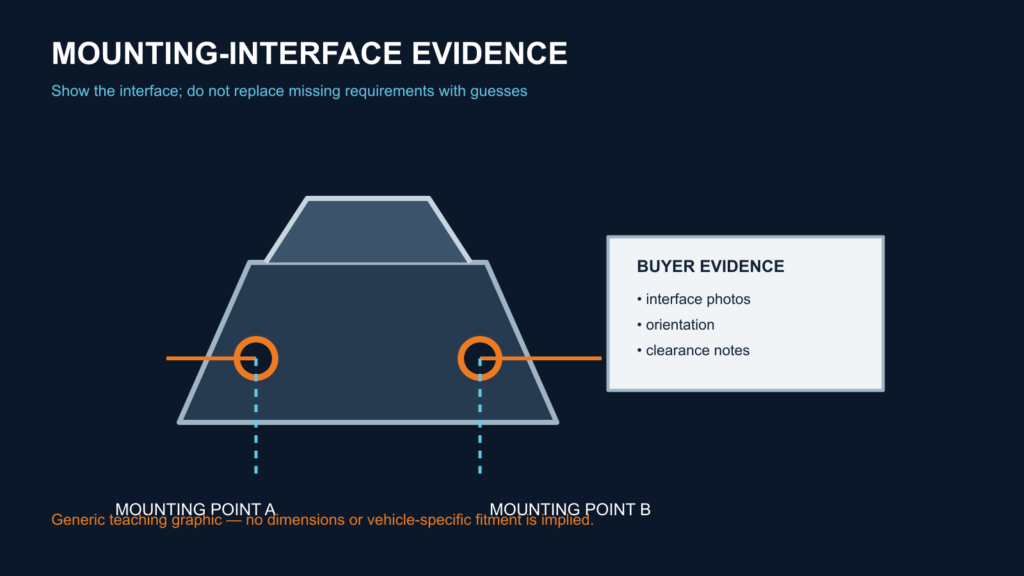
Fitment problems often begin at the interface between the part and the vehicle. Include clear evidence of every mounting point that the supplier is expected to use.
- Mounting-hole locations and hole-pattern references
- Bracket orientation and attachment direction
- Fastener information, if already specified
- Contact or clearance areas around the vehicle
- Left-right symmetry or intentional offset
- Photographs showing the part installed or the mounting area
Use photographs to show the vehicle from multiple angles, mounting area and any sample surfaces that must be preserved. They should support, not silently replace, the drawing.
5. State Material, Finish, Hardware and Packing Scope
Material and surface-finish information belongs in the quotation package, even when the final choice is still under discussion. State the requested material or list acceptable options for review. If the grade is not final, ask the supplier to quote the proposed material separately from any alternative.
Also identify the expected surface finish, colour, corrosion-protection requirement and visible appearance. Do not use a broad term such as “black finish” without explaining whether it is a preference, a reference appearance or a fixed requirement.
List hardware and accessories that are included in the requested supply scope. Clarify whether the quotation should include fasteners, brackets, spacers, installation instructions, labels or retail packaging. XCMOTOPARTS’s published solution information discusses material options, OEM process and packaging support, so these subjects can be included in the buyer’s inquiry for review.
If packaging is not yet defined, state whether you need individual protection, bulk shipment or private-label packaging, and leave the final specification open for review.
6. Identify Tolerances and Requirement Ownership
Not every dimension needs the same level of control. Mark the features that affect assembly, alignment, clearance, appearance or interchangeability. If the buyer does not have a tolerance requirement, say so and ask the supplier to identify the assumptions used for quotation.
Separate buyer-owned requirements from supplier recommendations. For example, the buyer may control the vehicle fitment reference and visible design, while the supplier may recommend a manufacturing detail or packaging arrangement for review. This distinction prevents an informal suggestion from being mistaken for an approved requirement.
A short open-points table can include:
- Requirement
- Current status
- Responsible party
- Decision needed before production
State whether the supplier should quote from a defined reference only or also comment on feasibility and propose changes.
7. Add a Revision Block and File-Control Notes
Every quotation package should have a revision identifier. Use consistent names for the drawing, photographs, sample references and supporting notes. When a file changes, update the revision and record what changed.
Note changes such as a modified mounting point, platform outline, finish or vehicle reference, and keep superseded files separate from the current package.
Before sending, check that dimensions, photographs and written requirements describe the same product.
8. Use Samples, Photos and Marked-Up References as Support
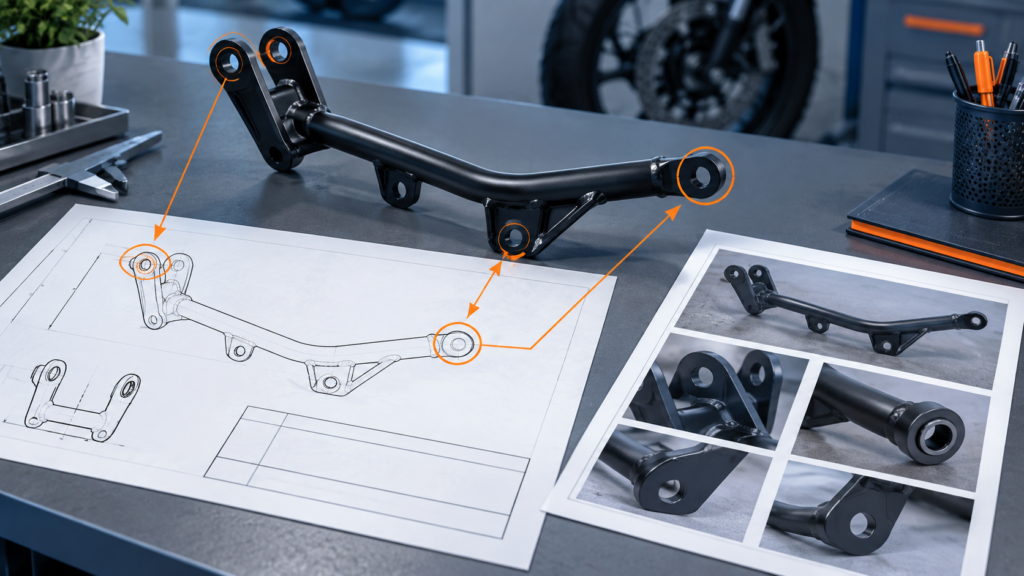
A physical sample can communicate shape, bend direction and mounting relationships; photos can show the installation environment and clearances; marked-up images can highlight the area to change.
Label each supporting reference as appearance, fitment, packaging or inspiration. If the sample is not final, say which features may change.
The sample or drawing should not be treated as proof of a particular material, tolerance, load capacity or production method unless that information has been confirmed. Ask the supplier to identify what still needs verification before the quotation becomes a production-ready specification.
Quote-Ready Motorcycle Parts Drawing Package Checklist
- Identify the exact vehicle, model year and market reference.
- Name the part and its mounting position.
- Select the controlling drawing, sample or reference set.
- Include enough views, datums and critical dimensions.
- Show mounting holes, brackets, clearances and symmetry.
- State material, finish, hardware and packaging requirements.
- Mark unknowns, open points and buyer assumptions.
- Add a revision number, date and controlled file names.
- Ask the supplier to list quotation assumptions and feasibility questions.
The decision path is straightforward: identify the application, choose the controlling reference, add fitment evidence, define the material and supply scope, mark unknowns, lock the revision and request a review. If the package is incomplete, a supplier can still comment on the missing information before preparing a final quotation.
Frequently Asked Questions
What should a motorcycle parts drawing package include?
It should identify the vehicle and application, provide the current drawing or sample reference, show critical views and dimensions, document mounting interfaces, state material and finish expectations, describe hardware and packaging scope, and include revision-control notes.
Can I request a quotation with photos instead of a CAD drawing?
Yes, photos and marked-up references can support an initial inquiry, especially when they show the vehicle, mounting area and part from several angles. For a comparable quotation, ask the supplier which missing dimensions or files are required before the scope is finalized.
Which dimensions are most important for a rear rack or crash bar?
The most important dimensions are generally the ones that control vehicle fitment, mounting-hole position, clearance, alignment, symmetry and the intended installation area. Mark these as critical and distinguish them from approximate or appearance-only dimensions.
Why should the drawing include a revision block?
A revision block tells the buyer and supplier which reference is current. It reduces the risk of quoting an outdated file and makes later changes easier to track.
What should buyers do when material or finish details are not final?
Mark them as open points and ask the supplier to state the quotation assumption or provide alternatives for review. Do not insert an unconfirmed material grade, finish, tolerance or performance figure simply to complete the form.
Send the Reference Package for Review
Once the drawing package is organized, send the current files, sample information and open questions together. For a broader development route, review the custom tubular motorcycle parts development information. Buyers can also review the published drawings and samples process before preparing an inquiry.
For products involving bends and tubular structures, the tube-bending review can help frame the technical questions. The material and surface finish guide is useful when the finish scope is still being defined. When the package is ready, use the B2B quote form and ask the supplier to confirm the reference, open points and quotation assumptions.