
A reported quality issue is not fully managed when the first email is sent. Buyers also need to track what is being contained, which product scope is involved, what action has been agreed, and what evidence will be reviewed before the buyer closes its follow-up record. A useful motorcycle parts corrective action checklist keeps those steps connected without treating an early explanation as a proven cause.
This guide is for importers, distributors, private-label buyers and supplier-quality teams managing a documented product concern. It describes buyer-side follow-up. It is not a legal claim procedure, a guarantee that a supplier uses a formal CAPA or 8D system, or a universal technical acceptance standard.
Quick Answer: What Should a Buyer Track?
Keep one traceable issue record with the order and approved product reference, affected scope, immediate containment, open questions, agreed actions, responsible owners, target dates, completion evidence and a planned effectiveness check. Close the buyer’s tracking record only when the agreed evidence has been reviewed and any remaining scope or decision is recorded.
Separate the Observation, Cause, Action and Closure Decision
Quality discussions become harder to review when an observation is written as if it were already a cause. Keep these items separate:
- Observation: what was seen or measured, where it was found, and which product or quantity it concerns.
- Cause explanation: the explanation being investigated and the evidence that supports or challenges it.
- Action: the agreed step intended to address the identified issue or reduce its recurrence risk.
- Verification: the evidence and review method the buyer will use to assess whether the action was completed and appears effective for the stated scope.
- Commercial disposition: a separate decision about return, replacement, credit or another remedy, governed by the order terms and agreement.
A corrected unit, for example, may address that unit’s condition without explaining why the issue occurred or whether other units are affected. Conversely, a revised work instruction may be documented while the buyer still needs evidence that the relevant product version was reviewed. The record should show which question each item answers.
Keep the Issue Traceable to the Approved Product
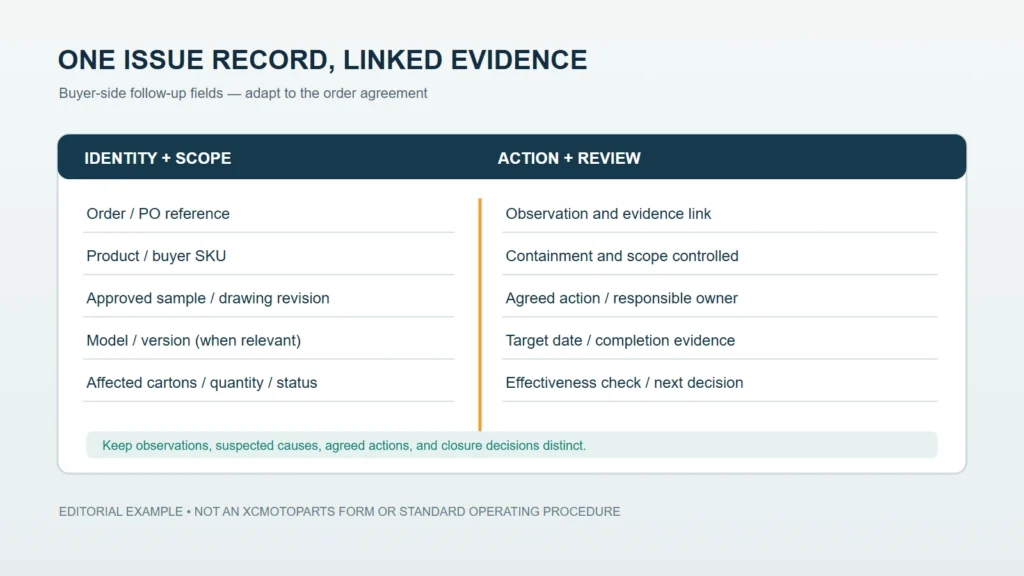
Carry the identifiers from the original report into every follow-up. At minimum, record the purchase-order or order reference, buyer part number or SKU, product name, approved drawing or sample revision, relevant motorcycle model and version where fitment matters, carton or batch references if available, and the quantity received, inspected and affected. Link the original photographs, measurements or packing records rather than copying a description without its evidence.
This matters for model-specific rear racks, crash bars, brackets and other tubular parts because similar-looking versions can differ at an interface or in their approved hardware. XCMOTOPARTS’ published batch-consistency guidance emphasizes keeping the approved sample or drawing, revision, application, dimensions, finish, hardware and packing reference identifiable. Use the reference that governed the order; do not silently substitute a newer image or message.
Record Interim Containment and Its Boundaries
When the issue may extend beyond one unit, the buyer should decide what immediate control is appropriate under its own receiving plan and agreement. Record the exact cartons, units, product versions or locations being held, screened or otherwise controlled; who owns that control; when it began; and what decision is still open. If the scope is unknown, say so explicitly rather than implying that an entire batch has been checked.
Containment is a temporary risk-control step, not a finding of fault. A buyer may need to keep affected stock separate while identity, condition or use is reviewed. If a concern could affect safe installation or structural use, stop the relevant installation, use or distribution and seek qualified technical review; a photograph or email exchange cannot establish that a part is safe.
Ask for a Cause Explanation Without Assuming the Answer
Ask the supplier to connect its explanation to the specific observation and approved reference. Useful questions include: Which requirement or process step was reviewed? What evidence was compared? Does the explanation apply to one unit, one carton, one revision or a broader scope? What information is still missing? If the evidence does not distinguish between possible explanations, keep the cause open.
XCMOTOPARTS’ public defect-claim guidance lists model version, production dimension, welding position, surface finish, missing hardware and packing damage as possible review directions. Its quality-inspection checklist also identifies items such as mounting-hole distance, bending angle, flatness and left-right symmetry. These are examples of product references a buyer may need to compare; they do not establish a cause, acceptance limit or responsibility in a particular case.
Make Each Agreed Action Reviewable
Write each action as a distinct, checkable line instead of a broad promise such as “improve quality.” A buyer-side action log can include:
- the issue or risk the action addresses;
- the affected product, revision and scope;
- the specific action agreed and its owner;
- the target date or next review date agreed by the parties;
- the completion evidence expected, such as an updated reference, review record or relevant photographs; and
- the status: open, evidence pending, ready for buyer review, or closed in the buyer’s tracker.
If a drawing, sample, hardware list, label or packing reference changes, identify the old and new versions and record who approved the change. Do not let an action log become a second uncontrolled specification. The applicable order agreement and approved revision remain the reference for the product.
Plan an Effectiveness Check Before Closing the Record
Completion evidence and effectiveness evidence answer different questions. A dated photo may show that a document or setup changed; it does not by itself show that later product conforms to the agreed reference. Before review, define what the buyer will compare, which product scope is included, what evidence is available, and who will make the buyer-side decision. The check may depend on the issue, product, agreement and available records. There is no universal sample size, pass rate or observation period that fits every motorcycle-parts concern.
For a fitment-related observation, the relevant reference may include the exact model version, mounting points and approved sample or drawing. For a hardware concern, the buyer may need the agreed kit list and evidence tied to the affected packing scope. For a surface or transit concern, the original condition, packaging and receiving context may be relevant. Choose the check that matches the reported issue instead of applying one generic photo review to every case.
Close, Continue or Escalate the Buyer-Side Follow-Up
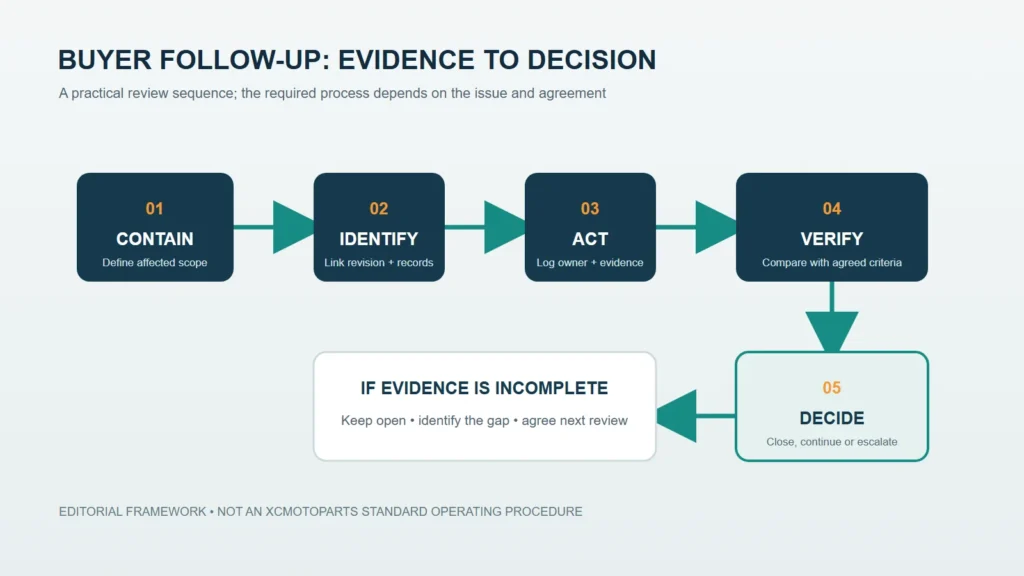
A buyer can close its tracker when the agreed action evidence has been reviewed against the defined reference and scope, the effectiveness check has been recorded, and unresolved items have an owner or a documented next step. Closing a tracking record does not automatically decide legal liability, warranty coverage or commercial remedy.
- Evidence incomplete: list the missing reference or record and request clarification.
- Scope uncertain: keep the buyer’s chosen containment in place and identify what remains unchecked.
- Action evidence available: compare it with the agreed product revision and action scope.
- Effectiveness unclear: leave the record open or agree the next review step.
- Technical or safety question remains: escalate to an appropriately qualified reviewer before releasing or using the relevant scope.
Frequently Asked Questions
What is the difference between correcting a part and following up on corrective action?
A correction addresses an identified condition on a product or scope. Corrective-action follow-up also tracks the explanation, agreed action, evidence and later review. The exact terminology and process should follow the parties’ agreement; this article does not define a formal standard.
What evidence should a buyer request?
Request evidence linked to the product, revision and affected scope: the relevant comparison reference, action completion record, and the evidence needed for the agreed effectiveness check. The right records depend on the issue and agreement.
Can a photograph prove that an action worked?
A photo can document a visible condition or change. By itself, it may not establish the correct revision, quantity scope, measurement method, cause or repeat-production result.
Does a buyer always need an 8D or CAPA report?
No universal report format applies to every commercial issue. Request a specific format only when it is required by the contract, quality agreement or project process.
When should affected stock remain on hold?
Follow the buyer’s agreed controls and qualified technical advice. If product identity, extent or safe use remains unresolved, keep the relevant scope controlled until the appropriate reviewer determines the next step.
Keep the Follow-Up Specific and Evidence-Based
A useful motorcycle parts corrective action record connects the original observation to the right product version, the exact affected scope, the agreed action and the evidence used for review. Keep causes provisional until supported, separate technical review from commercial disposition, and document what remains open. For XCMOTOPARTS’s public guidance on the initial after-sales report, see the buyer questions page; this article focuses on the buyer’s later tracking of agreed actions and review evidence. For product or sourcing discussions, use the contact page with the order or product reference and records available; handling steps and commercial outcomes depend on the applicable agreement.