
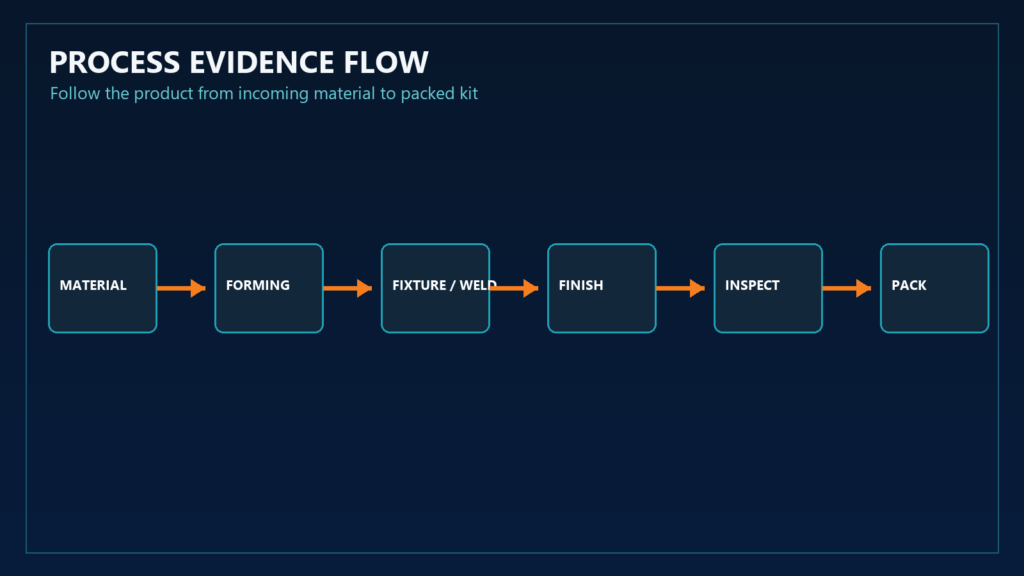
Quick answer: A motorcycle parts supplier quality audit should test whether the supplier can show controlled references, repeatable processes and reviewable records for the exact product you plan to buy. Start with the drawing or approved sample, then follow the part through material receipt, forming, fixtures, welding, finishing, inspection, packing and traceability. Treat a remote audit as evidence collection—not as proof that every future shipment will be defect-free.
This checklist is written for importers, distributors and private-label teams sourcing rear racks, crash bars, guards, brackets and other tubular metal parts. It helps you ask focused questions before relying on a supplier, while keeping supplier capability review separate from product-level pre-shipment inspection.
Define the Audit Scope Before Requesting Evidence
Write down the product, vehicle application, market version, current revision and order stage first. The relevant question is whether the controls apply to your part and approved configuration.
- Identify the product family, model/year or application reference, and saleable kit.
- State whether you are reviewing a quotation, a sample, a new production line or an existing repeat order.
- List the risks that matter most: mounting interfaces, symmetry, weld position, finish, hardware, labels or packaging.
- Separate documents the supplier can show from facts that still require an installed sample or shipment inspection.
Use the XCMOTOPARTS solution overview as a starting point for organizing drawings, samples, production and packaging questions. It is background context, not a substitute for project-specific evidence.
Review Drawing, Sample and Revision Control
Ask the supplier to identify the reference that controls the audit: a drawing, physical sample, marked-up photograph, approved kit list or another agreed document. The reference should have a clear name or revision so that the evidence you receive can be tied to one configuration.
Check how the supplier handles a changed hole position, bracket angle, tube route, finish, fastener or label. A useful review asks who evaluates the change, what evidence is compared, when the new version becomes effective and how old stock is separated. Do not accept “same as before” as a revision record.
For process context, see the supplier change-control guide. It does not confirm that every supplier uses the same document system.
Check Incoming Material Identification and Storage
Ask how incoming tube, sheet, fasteners or other materials are identified against the order or product reference, and what happens when identity, quantity, condition or paperwork does not match.
- What reference identifies the incoming material or purchased component?
- How are accepted, pending and rejected materials separated?
- How can the supplier connect material information to the production or batch record?
- Which material or finish details remain buyer-specified and still need confirmation?
A supplier quality audit should record what was actually observed and what was only described in a document. Do not turn an unverified material grade, certificate or storage practice into a published capability claim.
Follow Cutting, Tube Bending, Fixtures and Welding Controls
For tubular motorcycle parts, inspect the points where process variation could change fitment or appearance. Ask the supplier to explain how cutting references are set, how bend orientation is identified, how a fixture locates mounting interfaces and how weld position is checked before the part moves to finishing.
Focus on evidence that a buyer can review:
- current work reference and orientation marks;
- fixture or setup photos tied to the correct product;
- in-process checks for hole position, symmetry or other buyer-defined characteristics;
- weld inspection criteria and disposition of a nonconforming part;
- the method used to prevent a previous revision from entering the current order.
The motorcycle parts welding quality guide can help separate weld-specific questions from the broader supplier audit. A photo of a machine or fixture alone does not prove that it was used for your product.
Separate Surface Finishing and Outsourced-Process Evidence
Ask which finishing steps are performed in-house, which are outsourced and how the finished part is identified when it returns. Review how the supplier checks coverage, visible zones, holes, threads, masking and handling damage against the approved finish reference.
If a process is outsourced, ask for the handoff information and incoming check—not necessarily the subcontractor’s confidential commercial details. The important audit question is whether responsibility, revision and acceptance evidence remain clear across the handoff.
Do not treat a visual finish review as proof of corrosion performance, durability or a specific test standard unless the relevant evidence has been supplied and verified.
Examine Inspection Tools, Records and Calibration Claims
Ask what the supplier checks during production and before packing, which characteristics are recorded, and who reviews an out-of-specification observation. If measurement tools or calibration records are mentioned, request the exact scope and date that apply to the product or process under review.
Distinguish three kinds of evidence:
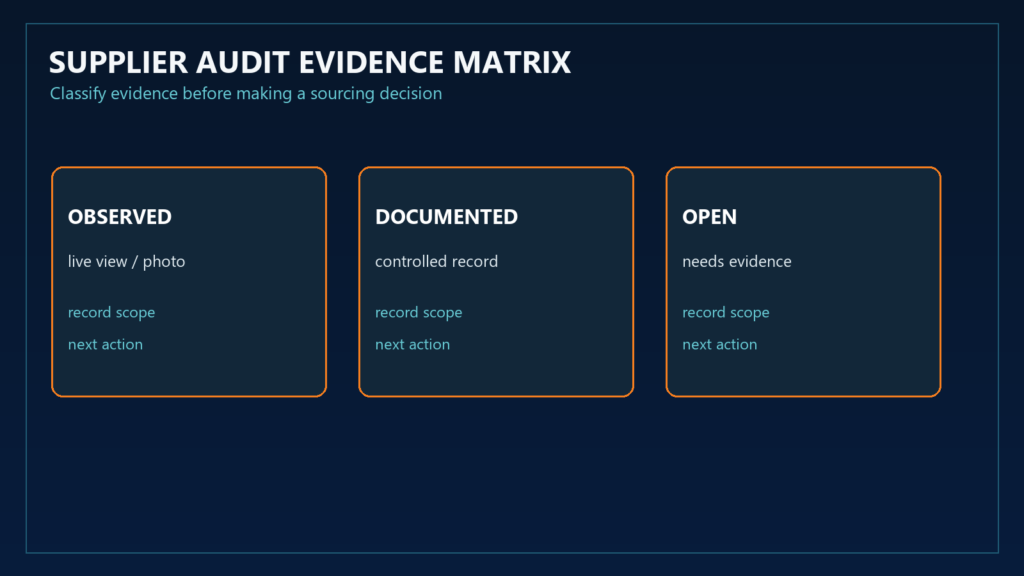
- Observed evidence: something you saw in a live review or dated photo/video.
- Documented evidence: a controlled record that identifies the product, revision and inspection scope.
- Unverified statement: a capability or policy described without supporting access or records.
Use the motorcycle parts quality inspection checklist for product-level inspection context. An audit cannot replace checking the actual shipment against approved requirements.
Review Nonconformance, Corrective Action and Change Handling
Ask what happens when a hole, weld, finish, hardware item, label or carton does not match the current reference. A practical audit looks for containment, identification of affected scope, a decision owner and evidence that the agreed action was completed.
Do not require a named corrective-action system unless the buyer and supplier have agreed it. Instead, ask the supplier to show how an issue is recorded, linked to the product or batch, reviewed and closed. Keep the distinction between an observation, a root-cause hypothesis and a verified corrective action.
Connect Packing, Labels and Traceability to the Product Revision
A quality audit should follow the identity of the product through the final kit and carton. Check whether the supplier can connect the product or kit list to hardware bags, left/right parts, labels, carton numbers, order references and any batch or revision record used by the project.
The traceability requirements guide explains why these links matter. It does not establish a universal barcode system or fixed record format. Ask for the fields that will actually be used on your order.
Remote Versus On-Site Audit: Know the Limits
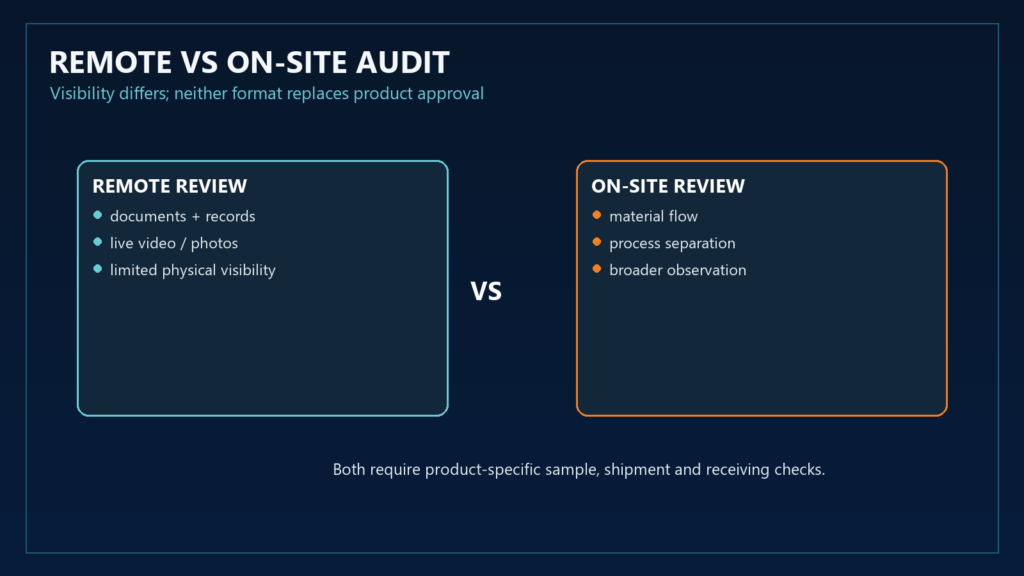
A remote review can examine shared drawings, records, live video, sample photographs and answers to a defined checklist. It is useful when travel is impractical, but it cannot independently verify every condition in a facility or prevent selective framing of a camera view.
An on-site audit may provide broader observation of material flow, storage, process separation and packing, subject to access. It still does not prove future output without product-specific approval and shipment checks. Record what was seen, sampled, inaccessible and still open.
Build a Risk-Based Scorecard Without Inventing Pass Marks
Use a simple status such as verified, documented but not observed, open or not in scope. Add a risk note for any gap that could affect fitment, structural condition, finish, hardware completeness, labeling or receiving.
Do not create a universal numerical pass mark unless your quality system requires one and the scoring method has been agreed. A supplier can be acceptable for a low-risk standard item and unsuitable for a model-specific part with unresolved mounting evidence.
Prepare an Evidence Request for the Supplier
Send the product/application reference, current drawing or sample revision, key risk points and the audit scope. Ask for a controlled list of available documents, process photographs or video, inspection records, open issues and the next verification step. After the review, keep an action log that names the affected reference and avoids unsupported conclusions.
For a sourcing discussion, use the XCMOTOPARTS quote contact path to share the product context and questions. The supplier should confirm which evidence is available for the specific project.
Frequently Asked Questions
What should a motorcycle parts supplier quality audit cover?
It should cover the product reference, revision control, material receipt, forming and welding controls, finishing, inspection evidence, nonconformance handling, packing and traceability. The scope should match the product and order risk.
Can a remote audit replace an on-site factory visit?
A remote audit can collect useful documents and process evidence, but it cannot show every physical condition. Record its limits and keep product-specific sample and shipment checks in the approval plan.
Which records should a buyer request from a motorcycle parts supplier?
Request records that identify the product, revision, inspection scope and decision owner, such as controlled references, in-process checks, nonconformance notes and packing or traceability records. The exact set must be agreed for the project.
Does an audit prove that every shipment will be defect-free?
No. An audit reviews capability and controls at a point in time. Approved samples, production checks, pre-shipment inspection and receiving evidence are still needed.
How should buyers review outsourced finishing or other processes?
Ask what is outsourced, how the current revision and acceptance criteria travel with the job, and what incoming check is performed when the process returns. Do not assume an outsourced step is controlled simply because it is named.
What should a buyer do when audit evidence is incomplete?
Mark the item open, state what evidence is missing and choose a next step: request records, observe a process, inspect a sample, or hold the sourcing decision. Do not convert an unanswered question into a pass.
Send a Reviewable Supplier-Audit Request
A focused audit request helps both sides discuss the same product and the same evidence. Include the application, revision, key risks, requested records, photo/video scope, open questions and decision date. Keep the result tied to the reviewed configuration, then validate the actual sample and shipment before release.