
Motorcycle parts traceability requirements should help a buyer and supplier identify which product version, production scope, carton and records belong together. This becomes especially important when similar-looking parts cover different motorcycle models, years, market versions or customer SKUs.
The objective is not to create the most complicated marking system. It is to agree on the simplest identifier path that can isolate the relevant products and retrieve useful records when a receiving question, version change or after-sales issue arises. Traceability identifies history and scope; it does not by itself prove quality, inspection approval or regulatory compliance.
Quick Answer: What Should a Traceability Requirement Connect?
A practical requirement should connect the buyer’s purchase order and part number or SKU with the approved product revision, the supplier’s batch or production reference, carton identification and the records both parties expect to retrieve. Depending on the product and contract, the traceability unit may be an order, batch, carton, hardware kit or individual part.
Before production, write down who creates each identifier, where it appears, which records reference it and how changes will be handled. This turns “traceability required” into an operational instruction that purchasing, production, packing, receiving and after-sales teams can use.
Separate Contractual, Regulatory and Operational Requirements
Start by asking why the traceability requirement exists. A law or market rule, a customer specification and an internal warehouse preference are not interchangeable. If an external requirement applies, the buyer should provide the exact document, required fields, marking method and approval owner. The supplier should not be expected to guess the applicable obligation.
If no external rule applies, define an operational level based on the number of SKUs, revisions, mixed cartons and likely review needs. Record-retention periods, barcode formats and individual serialization should be agreed only when the product, market and contract require them. This article is a purchasing framework, not legal advice.
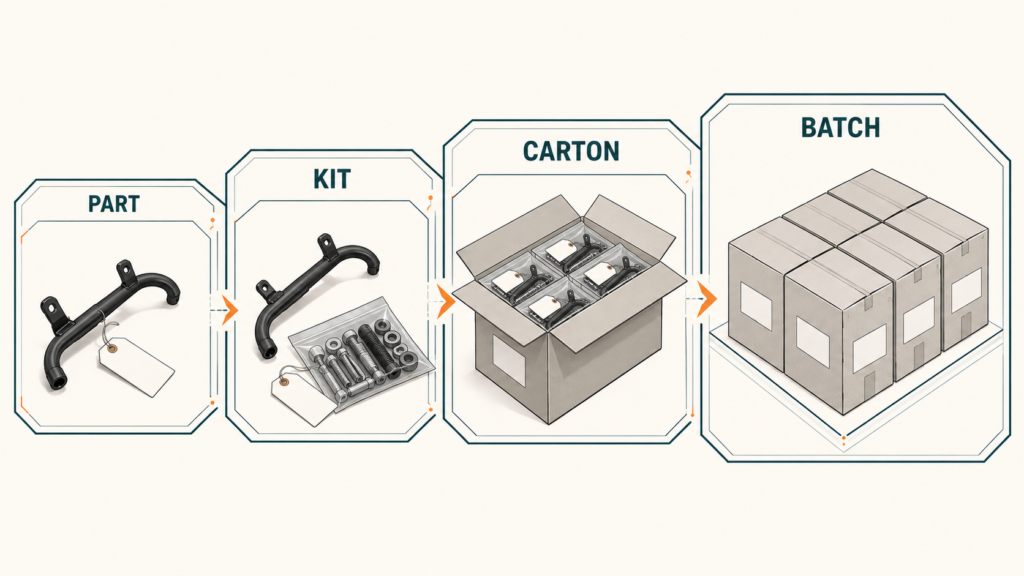
Define the Traceability Unit: Part, Kit, Carton or Batch
The correct unit is the smallest scope that must be distinguished to answer a realistic question. Order-level identification may work for one stable product version shipped together. Batch-level identification can separate production runs. Carton- or kit-level identification can help when multiple packages, models or hardware sets are involved. Individual-part serialization adds more marking and record work and should not be treated as the default.
| Traceability unit | Useful when | Key limitation to resolve |
|---|---|---|
| Order | One clearly controlled order scope | May not separate split production or mixed revisions |
| Batch | Production runs must remain distinguishable | The batch reference must follow relevant cartons and records |
| Carton or kit | Packages, hardware sets or SKUs can be mixed | Outer and inner identifiers need a defined relationship |
| Individual part | A contract or risk assessment requires unit-level identity | Marking feasibility, cost and record ownership must be agreed |
Choose the level before designing labels. Otherwise, a detailed carton label may still fail to identify which batch, kit or product revision is inside.
Choose the Identifiers Buyers and Suppliers Will Share
Use a short, controlled set of identifiers rather than several unrelated codes. A typical discussion may include the buyer’s purchase-order number, buyer SKU, supplier product reference, approved revision and batch or lot reference. Carton numbers or kit references can be added when packages need to be distinguished.
For each field, define its owner, format and location. State whether it appears on the purchase order, approved drawing or sample record, product label, hardware bag, carton label, inspection record or packing record. Also decide which identifier the buyer will quote when requesting support.
Link the Product Revision to the Order and Approved Reference
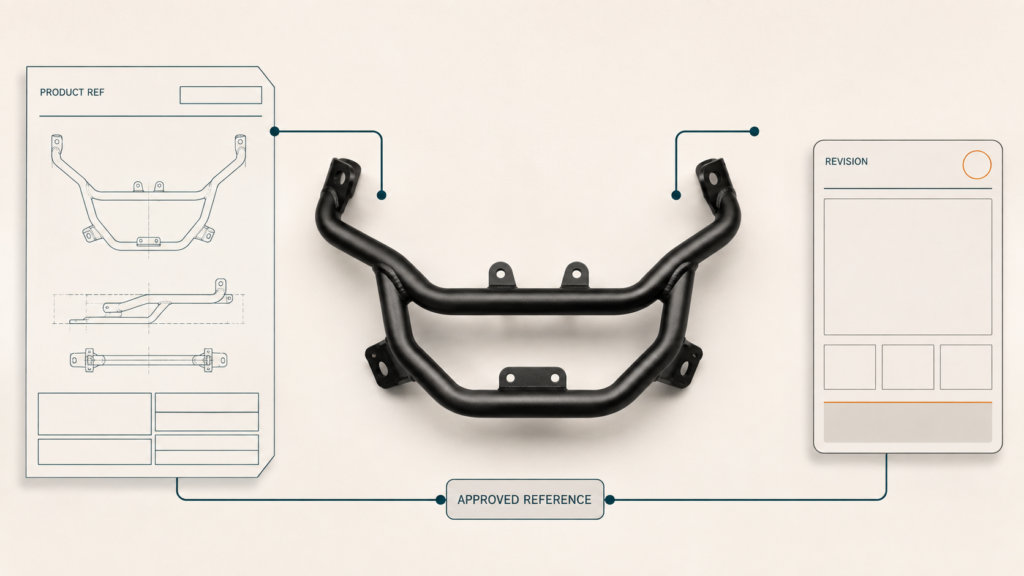
A batch number has limited value if it cannot be connected to the approved product version. The purchase order should point to one controlled drawing, approved sample or other agreed reference, including its revision identity. The production and packing records should use the same reference or a documented link to it.
XCMOTOPARTS’ published OEM process describes confirming the motorcycle model, year and market version and recording details such as finish, fasteners, labels, cartons and batch version before quotation. Buyers can also use the motorcycle parts batch consistency guide to define how an approved reference should be carried into repeat production. The traceability requirement adds the identifier path needed to retrieve that reference later.
Connect Hardware, Labels and Cartons Without Overcomplicating the System
A motorcycle metal part may travel with model-specific brackets, fasteners, instructions and labels. The system should make clear whether one kit reference covers all of these items or whether separate identifiers must be mapped to the same carton and batch.
Focus on relationships that support receiving and review. A hardware-bag label can reference the product or kit code; the carton label can reference the buyer SKU, package number and agreed batch identity; and the packing record can show how they were assembled. XCMOTOPARTS states that hardware can be checked against a checklist and packing photos can form part of the shipment record. Its packaging support information and branding requirements guide help separate protective packing and branding approvals from traceability records.
Decide Which Records Must Be Retrievable
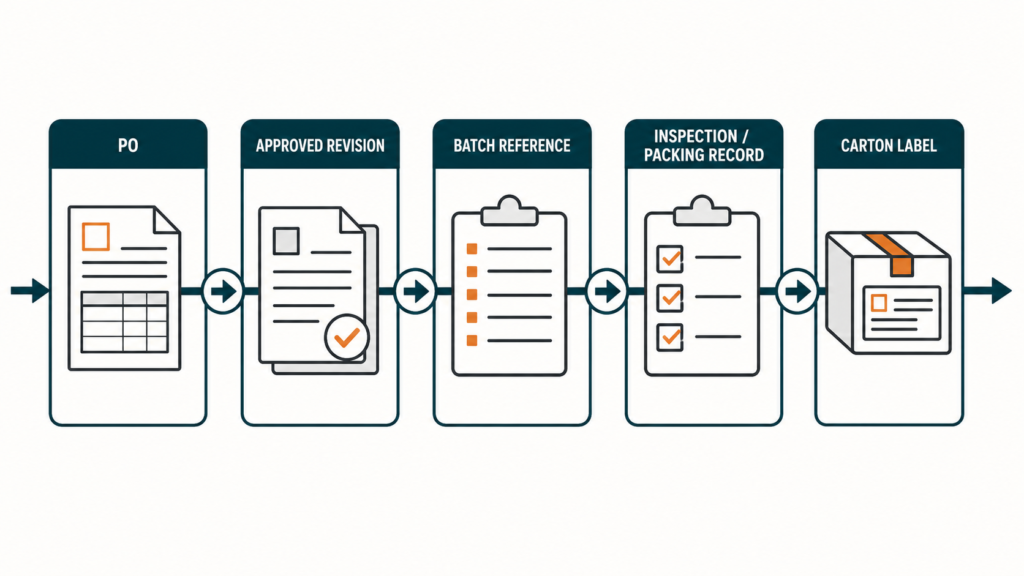
Agree on the records needed for the intended review. These may include the purchase order, approved revision, batch reference, relevant inspection record, packing checklist, packing photos and carton identification. Not every project needs every record, and the existence of a record should not be confused with proof that all requirements passed.
Define who stores each record, how the shared identifier finds it, who may request it and how long it must be retained. Retention should follow the contract, applicable market rules and an explicit buyer-supplier agreement. The motorcycle parts quality inspection checklist explains possible inspection evidence; the traceability requirement should specify how relevant evidence connects to the supplied scope.
Handle Split Batches, Rework, Replacements and Version Changes
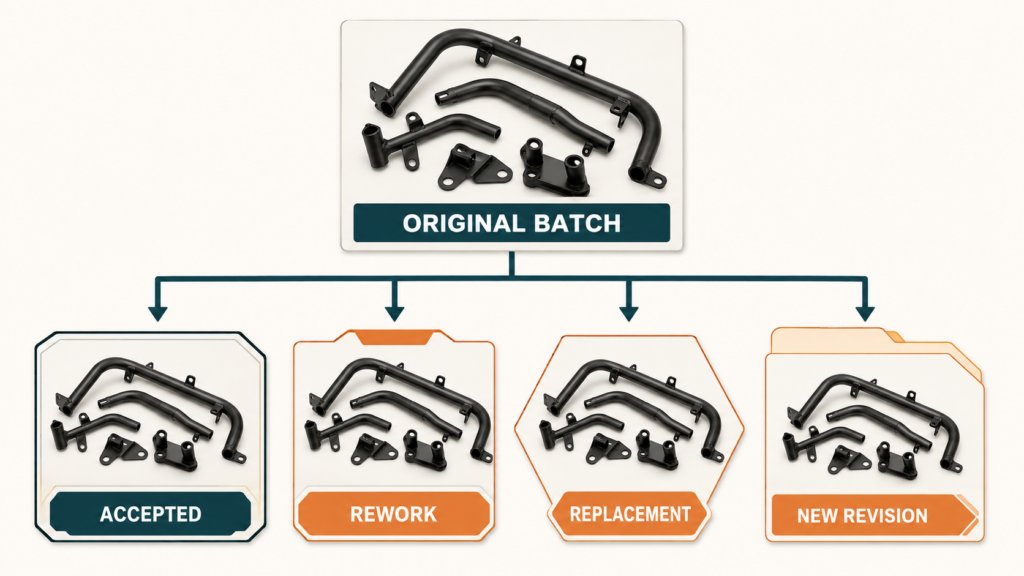
One original reference should not continue to describe different product scopes after a meaningful change. If a batch is split, identify the resulting groups where the distinction matters. If products are reworked, record whether they retain a linked batch identity or receive a new one. Replacement parts should point to the affected order and clearly identify their own production or shipment scope.
A new product revision should never be hidden under an old revision label. Update the purchase-order reference, batch or carton records and approval evidence affected by the change. The goal is a visible relationship between the original scope and the changed scope, not an unsupported claim that every processing step is traceable.
Decision Path: Confirm, Add Controls, Hold or Escalate
- Confirm: Identify any legal, customer or contractual requirement and the person authorized to approve it.
- Add controls: If no external rule applies, assess SKUs, revisions, carton mixing and after-sales needs, then select the simplest adequate unit.
- Hold: If the supplied identifiers cannot be connected to the approved revision and required records, pause release and clarify the path before shipment.
- Escalate: When split batches, rework, replacements or version changes create a new scope, add or link the necessary record and obtain the required approval.
Use Traceability During Receiving and After-Sales Review
Receiving teams should compare the purchase order, buyer SKU, carton label, product or kit identity and expected revision before stock is mixed or distributed. If information conflicts, preserve photos of the product and labels and isolate the relevant cartons while the identifier path is reviewed.
For after-sales questions, provide focused evidence instead of a general description. XCMOTOPARTS’ published after-sales response guidance asks for photos, model details, order records, carton labels and batch information as starting inputs. Those items are more useful when both parties agreed in advance how they connect.
Frequently Asked Questions
Is a carton label enough for motorcycle-parts traceability?
Only if the carton is the agreed traceability unit and its label can retrieve the correct product revision, batch scope and required records. Mixed models, kits or batches may require additional links.
What identifiers should follow a custom motorcycle part order?
Common candidates include the purchase order, buyer SKU, supplier product reference, approved revision, batch reference and carton or kit identity. Select only the fields needed for the contract and review process.
Should the approved sample and production batch use the same revision reference?
They should use the same controlled reference or a documented link that clearly shows which approved version the production batch follows.
How should reworked or replacement parts be identified?
Give the changed scope a new or linked record so it remains connected to the original order without being confused with unaffected products.
How long should motorcycle-parts traceability records be retained?
There is no universal period for every order. Retention should follow applicable market rules, the purchase contract and the buyer-supplier agreement.
Does traceability prove that a batch passed quality inspection?
No. Traceability connects identifiers and records. Inspection results and regulatory compliance require their own evidence and acceptance criteria.
Prepare a Traceability Requirement for Your Inquiry
Send the motorcycle model, year and market version; buyer and supplier part references; approved drawing or sample revision; preferred traceability unit; required label fields; packing structure; records to retain; and rules for split batches, changes and replacements. State any legal or customer-specific requirement separately and identify its approval owner.
Use the XCMOTOPARTS quotation form to share your product and identification requirements. A clear inquiry allows both parties to confirm what can be marked, linked and retrieved before sampling or production begins.