
Motorcycle parts first article inspection is a production-intent review of the first article made for a defined order or revision, before the supplier starts the batch. It confirms that the part, mounting interfaces and supplied configuration match the approved reference.
This is not automatically a certification exercise. SAE AS9102C is an aerospace first article inspection requirement; it is not automatically a motorcycle-parts requirement. The exact review record should be agreed for the project. For a motorcycle rear rack, crash bar, three-wheeler guard or other custom metal part, the goal is simple: approve the version that production is prepared to repeat.
Quick Answer: What Should Buyers Approve?
Before batch production, approve the first article against the current drawing, sample or controlled reference. Confirm the vehicle application, revision, orientation, fixture position, key dimensions, mounting-hole locations, tube route, bracket and weld positions, surface-finish intent, hardware kit and visible packing or identification requirements. Record open questions and the decision: approve, approve with documented conditions, revise and resubmit, or hold.
The first article is not a promise that every later unit will be identical, and it is not a substitute for final shipment inspection. It is the bridge between development/sample approval and production control.
What “First Article” Means in a Motorcycle Parts Project
A first article is the first representative part produced with the production-intent method, tooling or fixture, material and configuration defined for the order. “Production intent” matters because a hand-adjusted prototype can look acceptable while the repeatable setup introduces a different hole position, bracket angle or tube route.
The article may be a complete part or kit, depending on what the buyer needs to approve. Define this first. If a rack is supplied with spacers and bolts, checking the bare rack leaves part of the saleable configuration unreviewed. If several versions are involved, identify which version each first article represents.
Keep First-Article Review Separate From Other Inspection Stages
First-article inspection has a different job from the existing content on quality and production control:
| Review stage | Main question | What it does not replace |
|---|---|---|
| First article, before batch | Does the production-intent first piece match the approved product reference and application? | It does not prove the full batch or final shipment. |
| Pre-shipment inspection | Does the finished shipment meet the release checks for dimensions, fitment, finish, hardware and packing? | It does not resolve an unapproved production reference. |
| Batch consistency control | Are later units kept aligned with the approved reference and revision? | It does not replace the initial approval decision. |
Use the motorcycle parts quality inspection checklist for the pre-shipment stage and the batch consistency guide for repeat-production control. This article focuses on the decision immediately before the batch starts.
1. Confirm the Product Reference and Revision
Start by naming the exact product and application. Record the buyer SKU or supplier reference, available model information, left or right orientation, finish, hardware scope and current drawing, sample or marked-photo revision.
Do not approve a first article from a product name alone. A model family can contain different years, market versions or body configurations. A drawing may also show an earlier bracket or hole arrangement than the physical sample. If references disagree, pause the approval and state which controlled reference is intended to govern production.
XCMOTOPARTS’ public development wording says it reviews drawings, mounting points and product structure before development and can work from a drawing, sample or reference dimensions. That supports a reviewable input package; it does not by itself confirm a formal FAI report or a buyer-specific approval record.
2. Verify Fixture Positioning and Production Setup
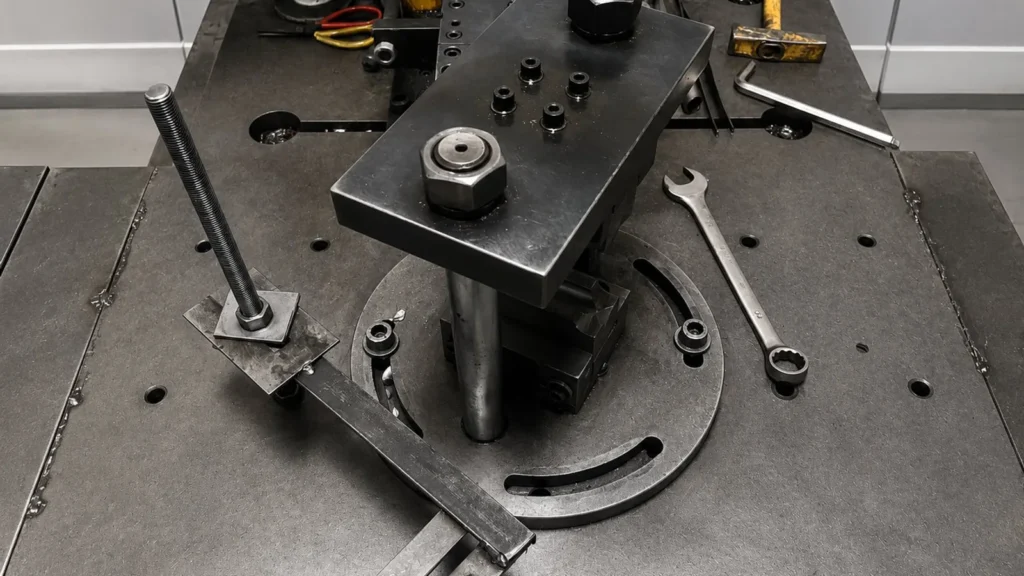
Ask how the first article was held while key interfaces were formed or joined. Fixture positioning matters when hole locations, symmetry, bracket orientation or weld location affect assembly. Review a setup photo or other agreed evidence when the fixture is part of the production-intent method.
The question is not whether a fixture looks sophisticated. The question is whether the setup controls the dimensions the buyer needs repeated. Check that the part is oriented correctly, that left and right features are not reversed, and that the fixture does not hide an interface that still needs a loose-fit check.
The public factory process lists fixture positioning to hold hole position and symmetry. Treat that as confirmed process context, not as a claim that every project uses one specific fixture or that the pictured fixture belongs to this order.
3. Check Fitment and Key Dimensions
Review the dimensions that control installation rather than measuring every feature without a decision purpose. These can include mounting-hole distance, bracket position, tube route, bend angle, width, clearance, flatness and symmetry.
Use the approved drawing or reference dimensions and, where possible, a fitment fixture or target vehicle. A part should reach its mounting points without being forced into position. Check the interfaces in a loose-fit condition before tightening hardware, and record any gap, interference or uncertain clearance for clarification.
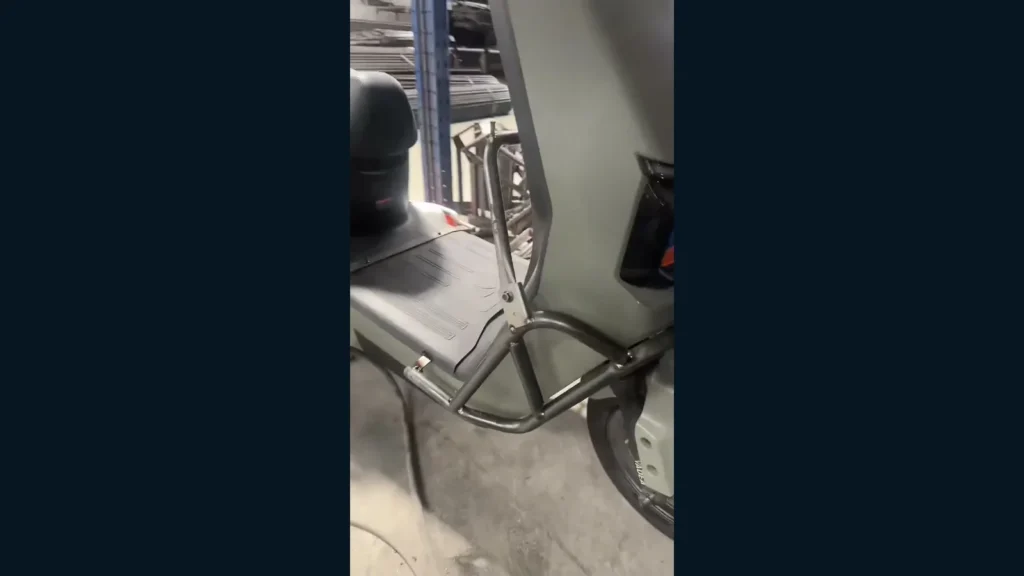
A fitment photo is useful evidence of context, but it is not a measurement record by itself. The review should identify what the photo proves and what still requires a dimension, sample comparison or physical check. For development background, see the custom tubular motorcycle parts development process.
4. Review Structure, Brackets, Weld Positions and Finish
Compare the first article with the approved structure. Check that tubes, tabs, brackets, holes and visible joints are in the expected positions and that no edge, weld bead or finishing condition blocks assembly. This is a visual and dimensional conformity review, not a claim of laboratory weld testing or structural certification.
Review the finish against the agreed reference after processing. Note visible damage, exposed areas, contamination or a finish that changes the usability of a hole or interface. Consult the motorcycle parts welding quality guide for welding-quality questions.
5. Approve the Complete Saleable Configuration
Lay out the parts that the buyer will actually receive. Confirm the hardware bag, spacers, brackets, labels and packaging reference where those items are part of the order. A first article with the correct metal shape but the wrong spacer or incomplete kit is not a complete approval of the saleable configuration.
For private-label or multi-SKU orders, keep model, side, finish and label versions separated. Mark any item that is still pending. The purpose is to prevent an approved physical part from being combined later with an unapproved hardware or packaging revision.
What Evidence Should the Review Record Contain?
A practical record can be short if it is specific. Include the product reference, revision, application, first-article date, reviewed dimensions or interfaces, fixture evidence if relevant, fitment result, kit scope, open issues, approver and final decision. Attach full-part and interface photographs.
Do not label a generic checklist as an official certification form. The record should use the fields agreed for the project. If a tolerance, material grade, load requirement or test method has not been supplied or confirmed, mark it as an open requirement instead of inventing an acceptance value.
First-Article Decision Path Before Batch Production
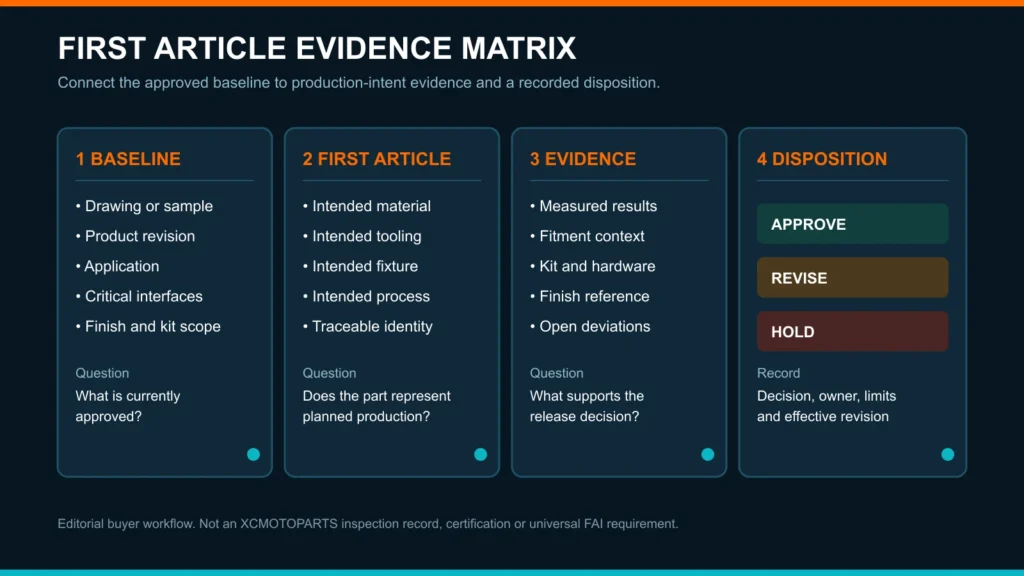
- Freeze the current product, application and reference revision.
- Confirm what the first article includes: part, pair, kit, finish, labels and packing.
- Review the production-intent setup, fixture orientation and critical interfaces.
- Check the key dimensions and fitment without forcing the part into position.
- Record visible structure, weld, finish and hardware findings.
- Classify every open item as approved, clarification required, revision required or hold.
- Release the batch only after the responsible buyer and supplier contacts agree on the current reference.
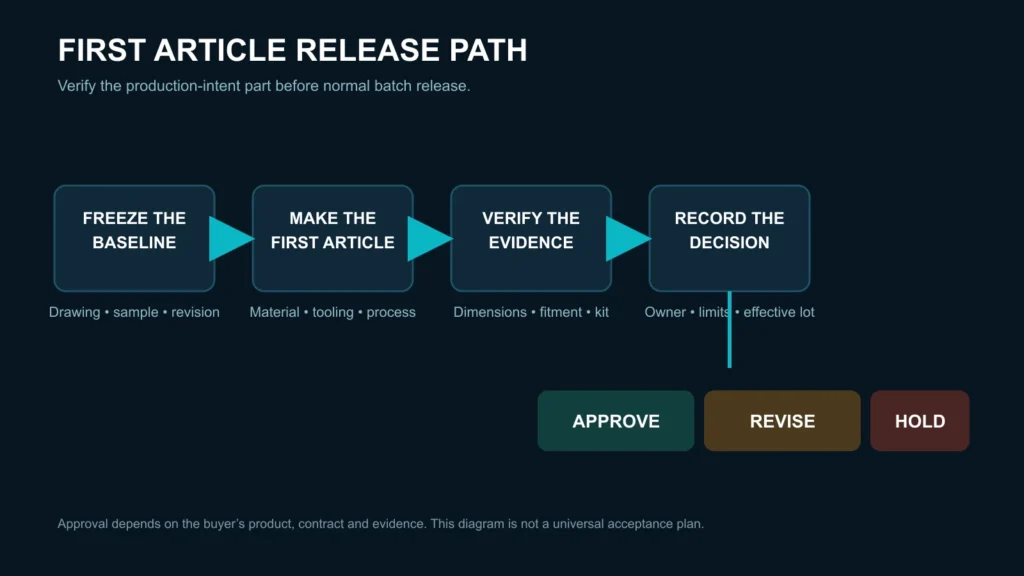
If the article fails a key fitment or reference check, changing the shipment inspection plan does not solve the upstream problem. Revise the part or reference, then review the new first article before the batch proceeds.
What First-Article Inspection Does Not Prove
One approved first article does not prove that every unit in the batch will match, that the part meets an unstated load or durability requirement, or that a national or industry certification applies. It does not replace incoming material checks, in-process checks or final packing checks. XCMOTOPARTS’ public quality overview describes incoming material, in-process dimension and final packing stages; those stages should remain distinct from the buyer’s production-intent first-article decision.
Frequently Asked Questions
Is first article inspection the same as pre-shipment inspection?
No. First article inspection approves a production-intent first piece before the batch starts. Pre-shipment inspection reviews the finished shipment before release.
Does every motorcycle parts project need AS9102?
No. AS9102 is an aerospace reporting standard, not a universal requirement for motorcycle parts. Agree the appropriate first-article evidence and acceptance record for the project.
Can a product photo approve a first article by itself?
Usually not. A photo can show general shape and context, but fitment and key dimensions need a drawing, sample, reference measurement, fixture or physical check appropriate to the product.
What happens when the first article needs a bracket or hole change?
Record the issue, update the controlled reference if the change is accepted, and review the revised production-intent article before releasing the affected batch.
Does an approved first article guarantee batch consistency?
No. It establishes the reference for production. Later units still need the agreed batch controls and final inspection evidence.
Prepare a Reviewable First-Article Request
Send the product application, drawing or sample, current revision, mounting-point photos, key dimensions, hardware scope, finish requirement and requested approval evidence. State which features are critical to fitment and which questions remain open. For a custom motorcycle rear rack, crash bar, three-wheeler spare part or other tubular component, use the XCMOTOPARTS quote contact path to discuss the available reference package before batch production is released.