
When a motorcycle parts order is ready to ship, the paperwork should describe the same products that were approved in the purchase order. A commercial invoice, packing list, transport document and any applicable origin document are not separate administrative tasks. Together, they tell the buyer, forwarder and customs broker what is being shipped.
This guide explains how B2B buyers can review motorcycle parts export documents before dispatch. The focus is document consistency: product descriptions, part numbers, quantities, carton counts and shipping details should agree with the approved PO, BOM and carton marks. Country-specific customs rules still need to be confirmed with the buyer’s local broker or import authority.
Quick Answer: Which Export Documents Should Buyers Check?
Before shipment, ask for draft copies of the commercial invoice, packing list and transport document. Add a certificate of origin or other supporting document when the destination, customer or customs process requires it. Compare every document with the approved purchase order, BOM, SKU list and carton marks before giving shipment approval.
The most useful check is not whether a document exists. It is whether the documents describe the same shipment without conflicting model names, quantities, carton counts, weights or consignee information.
Why Document Consistency Matters
Motorcycle parts are often shipped in mixed cartons or in several model versions that look similar. A short description such as “motorcycle accessories” may not give a buyer, forwarder or customs broker enough information to identify the contents. Clear descriptions and consistent references reduce questions during receiving and make later traceability easier.
Document checks also protect the approval record. If the buyer approved one version of a tubular guard, rear rack or mounting bracket, the shipping documents should refer to the same part number and model application. When a description changes between the PO, invoice and packing list, the buyer should pause approval and ask why.
Commercial Invoice: What Buyers Should Verify
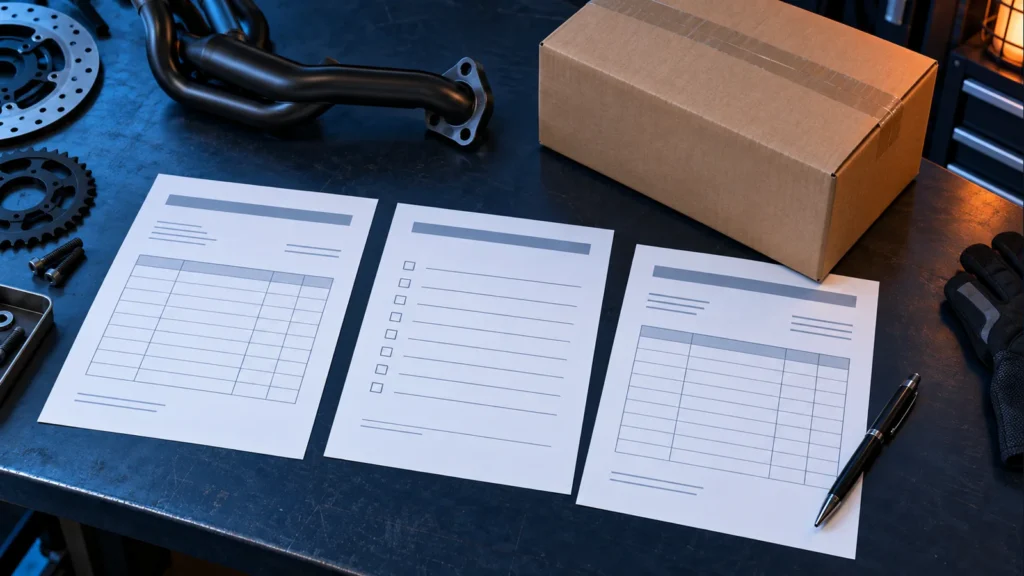
The commercial invoice normally supports the customs and payment process. Buyers should review the following fields against the approved order:
- seller and buyer names and addresses;
- invoice number and date;
- part number or SKU;
- plain product description;
- motorcycle model or application reference when relevant;
- quantity, unit price and total value;
- currency and agreed Incoterms;
- country of origin information when required; and
- shipping and consignee details.
The wording should be specific enough for the buyer to identify the item, but it should not include unsupported claims about certification, safety performance or material grade. If the item is a custom crash bar or rack, the description can refer to the approved part number and application without turning the invoice into a technical specification sheet.
Packing List: Match Cartons, Quantities and SKUs
The packing list should help the receiving team understand how the shipment is organized. It should be checked against the final packing arrangement and the approved BOM or kit checklist.
Review the number of cartons, carton or pallet references, part numbers, quantities per carton, total quantities, net weight, gross weight and dimensions when they are required for the shipment. For a mixed order, confirm that each SKU appears in the correct carton and that the total quantity adds up to the PO.
A packing list is not a substitute for a packaging checklist. The packaging checklist covers how the parts are protected. The packing list explains what is inside each shipping unit. Buyers should use both records together.
Transport Documents and Shipment Details
The transport document may be a bill of lading, sea waybill, air waybill or another document used by the selected carrier. The exact document depends on the transport arrangement. Buyers should check the draft with the freight forwarder and compare it with the commercial invoice and packing list.
Pay particular attention to the shipper, consignee, notify party, port or airport, package count, gross weight, marks and shipment reference. A small difference in a company name or carton count can create extra questions at the receiving end. If the shipment is consolidated with other cargo, ask how the buyer’s cartons and references will be identified.
Certificate of Origin and Country-Specific Requirements
A certificate of origin may be requested by the buyer, a customs broker or the destination authority. It is not automatically required for every motorcycle parts shipment. The issuing process and supporting evidence depend on the destination and the type of shipment.
For this reason, the supplier should not guess the required format. The buyer should confirm with the local importer, customs broker or official authority which document is needed, who should issue it and what information must match the invoice. The same caution applies to permits, declarations and other country-specific paperwork.
HS Code Responsibility: What Buyers and Suppliers Should Confirm
HS classification can affect customs processing, but the correct code depends on the product and the destination tariff system. A supplier can provide product information and a proposed classification when appropriate, but the buyer or appointed customs broker should confirm the final code for the importing country.
Do not use a convenient code simply because it appeared on an older shipment. If the product, material, function or destination changes, the classification may need to be reviewed again. Keep the discussion in the approval record so that the invoice, broker instructions and future reorders use the same confirmed reference.
Check Documents Against the PO, BOM and Carton Marks
The most practical review is a side-by-side comparison:
- PO: confirms the commercial scope, approved quantities and agreed shipping terms.
- BOM or kit list: confirms part numbers, included hardware and kit contents.
- Commercial invoice: confirms the declared products and transaction value.
- Packing list: confirms carton-level quantities and packing structure.
- Carton marks: help the receiving team identify the correct shipping unit.
- Traceability record: connects the shipment to the approved revision or batch reference when one is used.
The carton marks should follow the approved carton marking requirements. A buyer does not need every document to use identical wording, but the core identifiers must point to the same products and quantities.
The Pre-Shipment Document Approval Process
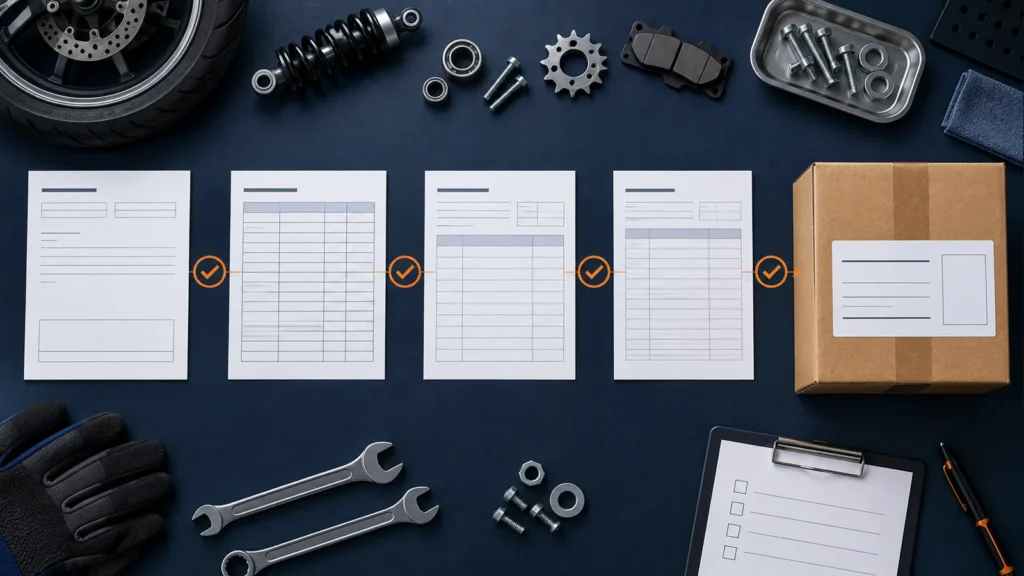
A simple approval sequence avoids last-minute corrections:
- Confirm the latest PO, BOM and approved product revision.
- Request draft invoice, packing list and transport details before dispatch.
- Compare part numbers, model references, quantities and carton counts.
- Ask the forwarder or broker to confirm any destination-specific documents.
- Return one consolidated list of corrections instead of sending scattered comments.
- Approve the final document set and keep the approved version with the order record.
This process is especially useful when several similar motorcycle parts share packaging or when an order contains multiple model applications. The goal is not to create unnecessary paperwork. It is to make the approved shipment easy to identify at every handoff.
What to Do When Documents Do Not Match
Do not silently edit one document and leave the others unchanged. First identify which record is the latest approved reference. Then ask the supplier, forwarder or broker to revise the affected documents as a consistent set.
Common mismatches include a part number that differs from the PO, a packing list with the wrong carton total, a model description that is too broad, or a consignee name that does not match the shipping instruction. Record the correction and confirm the final version before release.
Buyer Checklist Before Shipment
- Have the latest PO and BOM been used?
- Do invoice descriptions identify the actual parts clearly?
- Do quantities and values match the approved order?
- Does the packing list match carton contents and carton marks?
- Do package count, weight and dimensions match the forwarder’s information?
- Are consignee, notify party and destination details correct?
- Has the buyer’s broker confirmed any country-specific documents?
- Has the final document set been approved and archived?
Frequently Asked Questions
What export documents should buyers request for motorcycle parts?
Start with the commercial invoice, packing list and transport document. Add origin documents or other supporting paperwork when the destination process requires them.
Should the packing list match the motorcycle parts BOM?
It should match the shipped kit contents and quantities. If the packing arrangement differs from the BOM, record the approved change so receiving staff can reconcile it.
Who confirms the HS code for motorcycle parts?
The importing buyer or appointed customs broker should confirm the final code for the destination country. The supplier should provide accurate product information and use the confirmed reference in the document set.
Why approve draft documents before shipment?
Draft review gives the buyer time to correct product descriptions, quantities, consignee details and carton references before the documents are used for transport or customs processing.
Are export document requirements the same in every country?
No. Requirements can vary by destination, product type, transport method and importer status. Confirm local requirements with the buyer’s customs broker or official authority.
Final Takeaway
Good export documentation is a consistency check across the whole order. Buyers should compare the invoice, packing list and transport details with the approved PO, BOM, carton marks and revision record before shipment. When the documents agree, the shipment is easier to identify, receive and trace. When they do not, correction is usually simpler before dispatch than after the cargo has moved.
For related preparation, review the purchase order checklist, traceability requirements and quality inspection checklist. Buyers can also contact XCMOTOPARTS with their drawing, BOM and shipment requirements for a document review discussion.