
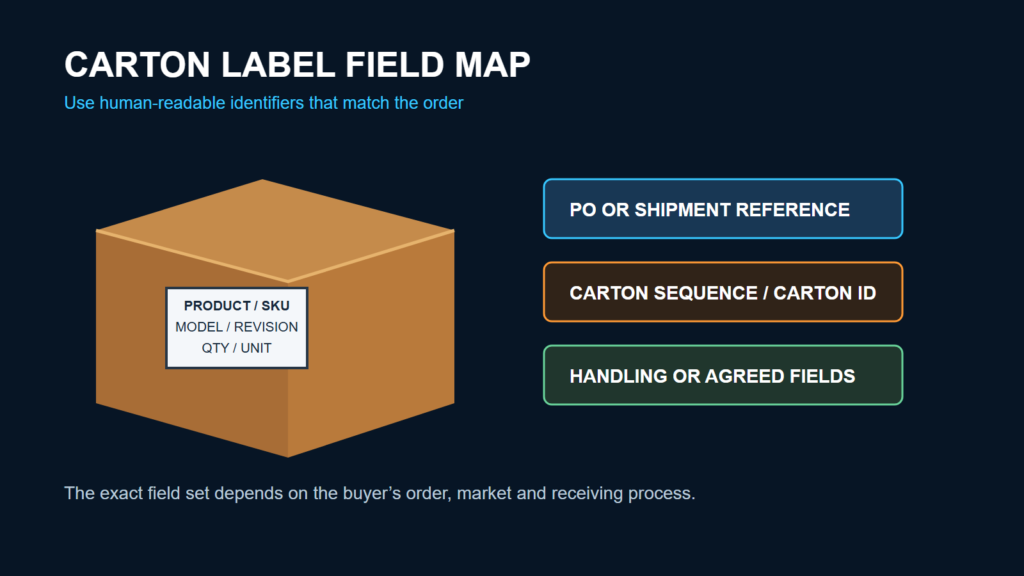
Motorcycle parts carton marking requirements should answer one practical question: can the receiving team identify, count and route the correct carton without guessing? A useful outer-carton mark normally connects the product or buyer SKU with the applicable model or version, quantity and unit, purchase-order reference, carton sequence and any agreed handling or legal fields.
The exact fields depend on the product, market, contract and warehouse process. For a model-specific rear rack, crash bar or tubular guard, the carton mark should also prevent similar-looking parts, hardware kits or revisions from being mixed. The goal is not to fill the carton with decorative information. The goal is to make the shipment easy to verify before stock is distributed.
Build the Carton Mark Around the Receiving Question
Start by listing the questions a warehouse or importer must answer when cartons arrive:
- Which product, SKU or kit is inside?
- Which motorcycle model, year or market version does it serve?
- How many saleable units or inner packs are in this carton?
- Which purchase order, shipment or packing reference does it belong to?
- Is this carton part of a numbered sequence?
- Does the carton contain one approved version, or are mixed contents clearly identified?
- Are there handling instructions or market-specific fields that the buyer has approved?
This receiving focus keeps carton marking separate from general protection. The wholesale packaging checklist can help define inner protection, separators, hardware packing and other physical packaging details. Blog 25 should focus on the information printed, attached or otherwise assigned to the outer carton.
Identify the Product, Model and Approved Version
A product description such as “motorcycle rack” may be too broad for receiving. Similar racks can serve different motorcycles, model years or market configurations. A carton mark should use the buyer-approved product identity rather than relying on a general category name.
Depending on the order, the identity block may include:
| Field | What the buyer should define |
|---|---|
| Product or buyer SKU | The identifier used by the buyer’s purchasing and warehouse systems. |
| Product description | A clear description of the rack, crash bar, guard, bracket or kit. |
| Model reference | Make, model, year or market version where these affect fitment. |
| Kit or component scope | Whether the carton contains a complete saleable kit, a main part or replacement components. |
| Revision | The approved drawing, sample, BOM or artwork revision when version control is needed. |
These fields should match the buyer’s approved order information. They should not introduce a new product name or an unapproved model description at the packing stage. If a carton label differs from the purchase order or approved reference, the receiving team may need to hold the carton before it is put into stock.
For a deeper record relationship, review the motorcycle parts traceability requirements guide. Traceability is broader than a carton label: it concerns how product, revision, batch, carton and records are connected. A carton mark can support that relationship, but it does not prove quality or compliance by itself.
Show Quantity, Unit and Carton Sequence Clearly
Quantity information is useful only when the unit is unambiguous. “20” could mean 20 complete racks, 20 pairs of brackets, 20 hardware bags or 20 inner packs. The buyer and supplier should agree what the quantity describes and where that quantity is counted.
A carton-marking brief should clarify:
- Quantity of saleable units per carton.
- Unit of measure, such as set, piece, pair, kit or inner pack.
- Whether hardware bags or replacement parts are included in the stated quantity.
- Whether an inner-pack quantity is different from the outer-carton quantity.
- Whether the carton is full, partial, mixed or reserved for replacement items.
- Whether carton numbering follows the shipment, purchase order or product line.
A neutral sequence such as “CARTON 1 OF 3” can help a warehouse confirm that the shipment is complete. It should be used only when the numbering rule is agreed. If different products or model versions are packed in the same shipment, the sequence should not be the only identifier. The product or SKU and carton scope still need to be visible.
Connect the Carton to the Order and Shipment
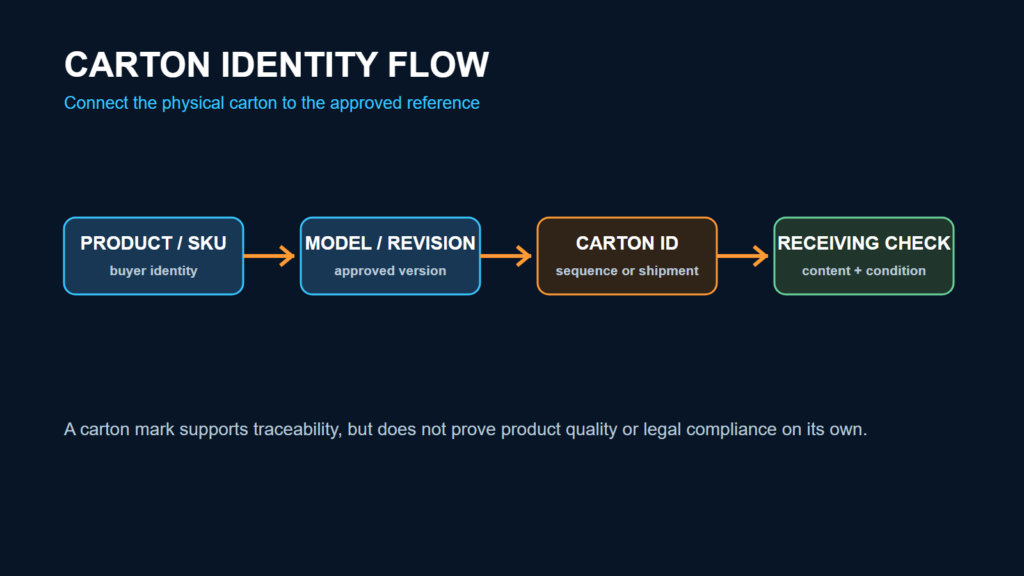
Carton marks should connect physical stock to the commercial references used by the buyer. Common fields may include a purchase-order number, buyer reference, shipment reference, packing-list line or carton ID. The correct combination depends on the order and receiving process.
The purchase-order checklist can help buyers define the commercial information before release. The carton should not be expected to replace the purchase order, packing list or transport documents. Instead, its identifiers should make it easier to compare the carton with those documents.
For example, a receiving team may compare the following chain:
- The carton ID and product/SKU shown on the outer carton.
- The product and quantity expected on the purchase order.
- The carton sequence and quantities listed on the packing reference.
- The model, kit or revision information approved for that order.
- The physical contents and packaging condition at receipt.
If those references do not agree, record the discrepancy and isolate the affected carton until the buyer and supplier clarify the scope. Do not silently replace a carton mark with a new label if doing so would remove the original evidence.
Treat Weight, Dimensions and Handling Marks as Controlled Fields
Gross weight, net weight and outer dimensions may be useful for warehouse planning, freight arrangements or receiving checks. They should be recorded according to an agreed method and timing. Buyers should define whether the information is required on every carton, on the packing document, or in both places.
Handling marks should also be purposeful. Depending on the packed product, a buyer may need orientation, keep-dry, protection or stacking information. These marks should reflect the actual packing arrangement and handling risk. They should not be added as decoration or copied from a different product.
Country-of-origin wording and other legal or destination-specific marks require special care. Their requirements can vary by destination, product, contract and transport arrangement. The importer, customs professional or carrier should confirm what is required. This guide does not establish a universal legal marking rule, and a supplier should not be presented as responsible for destination-country compliance without a documented agreement.
When weight or packing scope affects quotation assumptions, the motorcycle parts manufacturing cost factors resource provides supporting context. Keep the article’s main decision focused on identification and receiving rather than landed-cost calculation.
Decide Whether a Barcode or Scan Field Is Needed
A barcode or other machine-readable mark may help a warehouse, but it should be introduced only when the buyer’s system and receiving process can use it. Before requesting one, define the data owner, barcode format, encoded fields, label size, print quality, quiet zone, placement and verification responsibility.
A barcode should support the human-readable product and carton information, not replace it. If a scan fails, the receiving team still needs enough text to identify and hold the carton. Buyers should also confirm whether the supplier can receive, print or verify the required artwork for the relevant order. Do not assume that a barcode, QR code or scan-verification process is available unless it has been confirmed.
Approve Artwork and Carton-Mark Revisions Before Packing
Carton artwork often combines operational fields with private-label presentation. Keep those purposes separate during approval. The buyer should identify which text is required for receiving, which elements are branding, who owns the artwork and which revision is approved.
When a SKU, model, carton sequence, logo, handling instruction or revision changes, replace the old reference clearly. A product can be correct while its carton label is obsolete. The supplier change control guide provides a useful framework for reviewing the affected reference, evidence, approval route and effective order or batch.
Save the approved label proof with the relevant PO, product reference or packing instruction. If the buyer cannot tell which proof was used, the label may create a new version-control problem instead of solving a receiving problem.

Handle Mixed Models, Versions and Split Shipments
Mixed cartons deserve an explicit rule. If one carton contains different SKUs, model versions, left/right components or optional items, the outer mark should identify that scope clearly, or the items should be separated into identifiable inner packs.
For split shipments, define whether the sequence continues across the entire order or restarts for each shipment. A carton number without a shipment reference may be ambiguous when the same order is dispatched in multiple stages. The same principle applies to replacement cartons and partial cartons: identify what is inside and which approved version it belongs to.
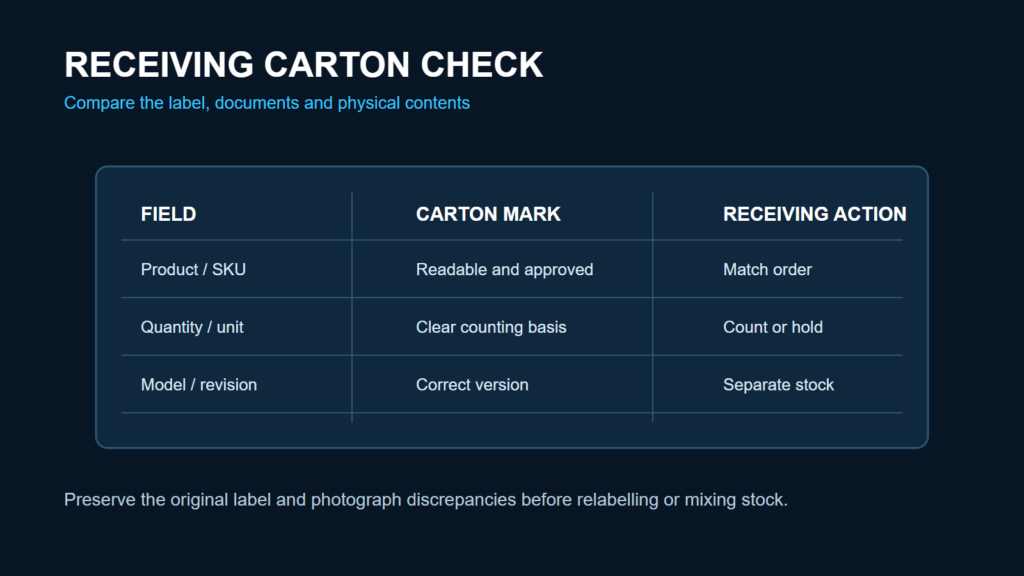
Receiving teams should avoid mixing stock before identity questions are resolved. If the carton, product, hardware bag and order reference disagree, photograph the condition, preserve the label and hold the affected scope for review.
Receiving Checklist for Importers
At receipt, compare the physical shipment with the agreed carton-marking brief:
- Carton count and carton sequence are complete.
- Product name or SKU is readable and matches the order.
- Model, version or kit identity is correct where applicable.
- Quantity and unit are clear and consistent with the packing reference.
- PO, shipment or carton ID can be matched to the receiving record.
- Handling marks are present when agreed and relevant.
- Carton condition and visible labels are recorded before relabelling.
- Mixed, partial or replacement cartons are identified separately.
- Any barcode or scan field is checked against the human-readable information.
For general physical protection and packing checks, return to the wholesale packaging checklist. For product-version and record relationships, use the traceability requirements guide. Keeping these resources separate helps the importer investigate the correct issue instead of treating every carton problem as a packaging failure.
Frequently Asked Questions
What should a motorcycle-parts carton label include?
It should include the product or buyer SKU, a clear description, model or approved version where relevant, quantity and unit, PO or shipment reference, carton sequence and any agreed handling or legal fields. The final field set should match the buyer’s receiving process.
Does every carton need a carton number?
Not every order needs the same numbering method. Carton numbers are especially useful when a shipment has multiple cartons, split deliveries, mixed products or a receiving process that checks completeness. Agree the numbering scope before packing.
Should motorcycle-parts cartons use barcodes?
Use barcodes when the buyer’s warehouse system needs them and the data format, artwork, placement and verification method have been agreed. Keep human-readable identifiers on the label so a failed scan does not make the carton impossible to identify.
How should mixed models or revisions be marked on cartons?
Use separate cartons or clearly identified inner packs where practical. If mixing is necessary, list the product, model or revision scope in a way the receiving team can compare with the order. Do not rely on a generic product description or carton sequence alone.
Are country-of-origin and shipping marks always legally required?
Requirements vary by destination, product, contract and transport arrangement. The importer and its customs or logistics advisers should confirm the applicable rules. This article provides an operational marking framework, not destination-country legal advice.
What should an importer check when cartons arrive?
Check carton count, sequence, product/SKU, model or version, quantity and unit, PO or shipment reference, visible condition and any agreed handling or barcode fields. Preserve evidence and isolate discrepancies before stock is mixed or distributed.
Prepare a Carton-Marking Brief Before Quotation
Before requesting a quotation, send the product or SKU, model and version information, required quantity per carton, carton-sequence rule, label artwork, barcode decision, handling needs, receiving constraints and any market-specific requirements that have been confirmed by the responsible party.
Clear carton marking helps the buyer and supplier discuss the complete delivery scope before packing begins. To submit a model-specific carton, label or packaging requirement for review, use the B2B quote form.