
A motorcycle parts catalog needs more than a product name and photo. This motorcycle parts catalog data checklist helps distributors connect product identity, application details, saleable configuration, hardware, packaging and supporting references before publishing or reordering model-specific metal parts.
The purpose is not to create the longest possible model list. It is to give sales, purchasing, warehouse and after-sales teams the same controlled description of what a listing represents. This buyer-side framework does not confirm the fitment, regulatory status or availability of any particular product.
Quick Answer: What Catalog Data Should Be Verified?
A distributor should connect every saleable motorcycle part with a unique product reference, the exact application being claimed, its current configuration, included hardware or package scope, supporting images or approved references, and a clear release status. An unverified field should remain marked for clarification rather than being published as confirmed fitment or specification.
Define the Product, Variant, SKU and Application
Marketing names help customers browse, but they should not be the only identifiers behind a B2B listing. A stable product reference allows purchasing, warehouse and supplier teams to discuss the same item when an order, image, finish or revision changes.
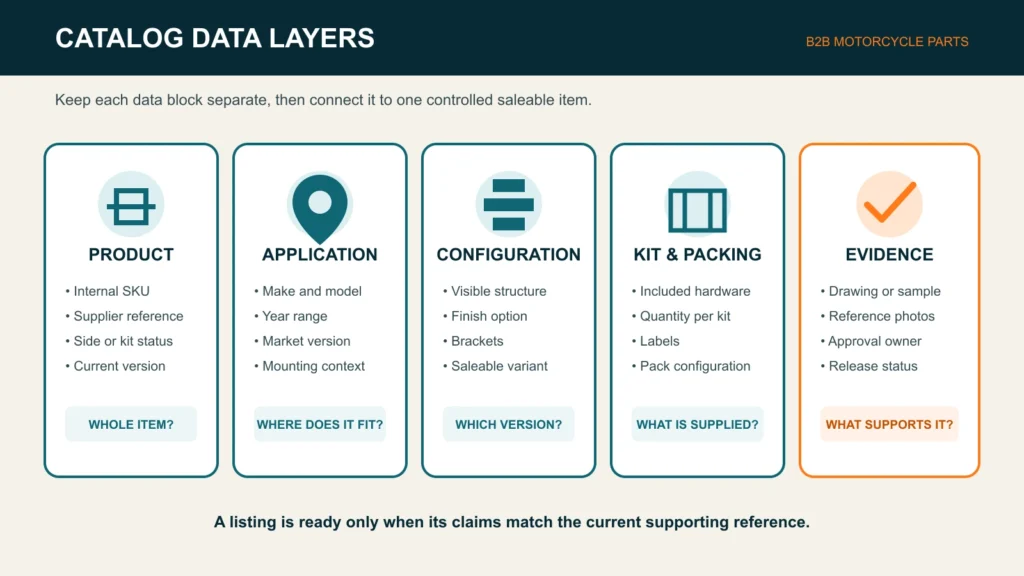
Where applicable, a catalog record should identify:
- the distributor’s internal item number or SKU;
- the supplier’s agreed product reference;
- left-hand, right-hand, paired or kit status;
- the current drawing, approved sample or reference-photo identifier;
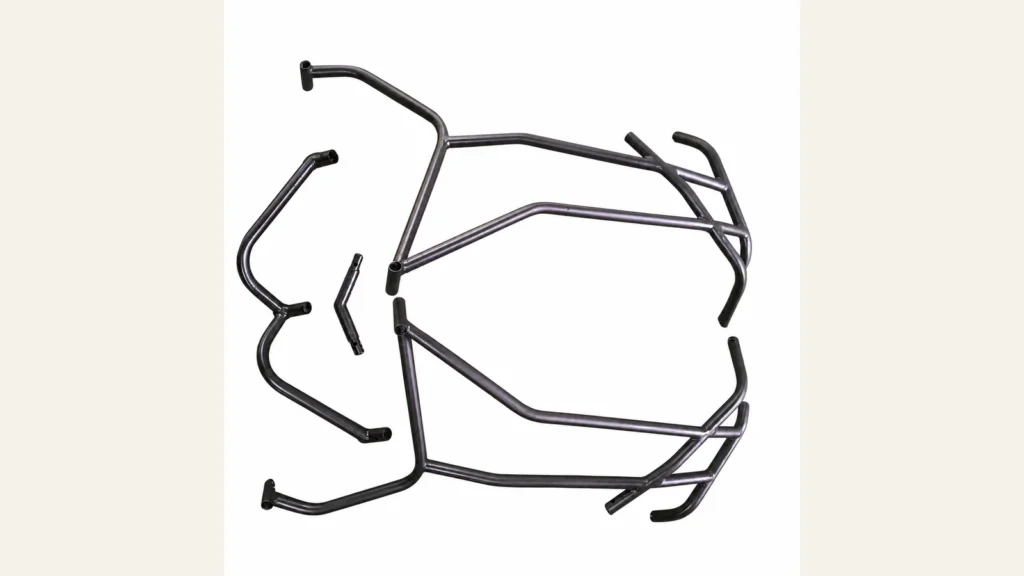
- the visible configuration or finish when it changes the saleable item; and
- whether the record is ready for release, needs clarification or is not approved for publication.
For a project that begins with a drawing, physical sample, photographs or basic measurements, keep the original source linked to the product record. The custom tubular motorcycle parts development guide explains how buyers can organize those inputs before they become production or catalog decisions.
Record Model, Year and Market Fitment Without Guessing
A motorcycle model name may not distinguish model year, regional version, mounting arrangement or other details relevant to a model-specific accessory. Fitment data should therefore be stored as a controlled application record, not only as a line of sales copy.
Depending on the product, the application record may need the motorcycle make and model, confirmed year or year range, market version, mounting location, product side and the reference used to support the statement. When an application remains uncertain, the catalog should say that clarification is required.
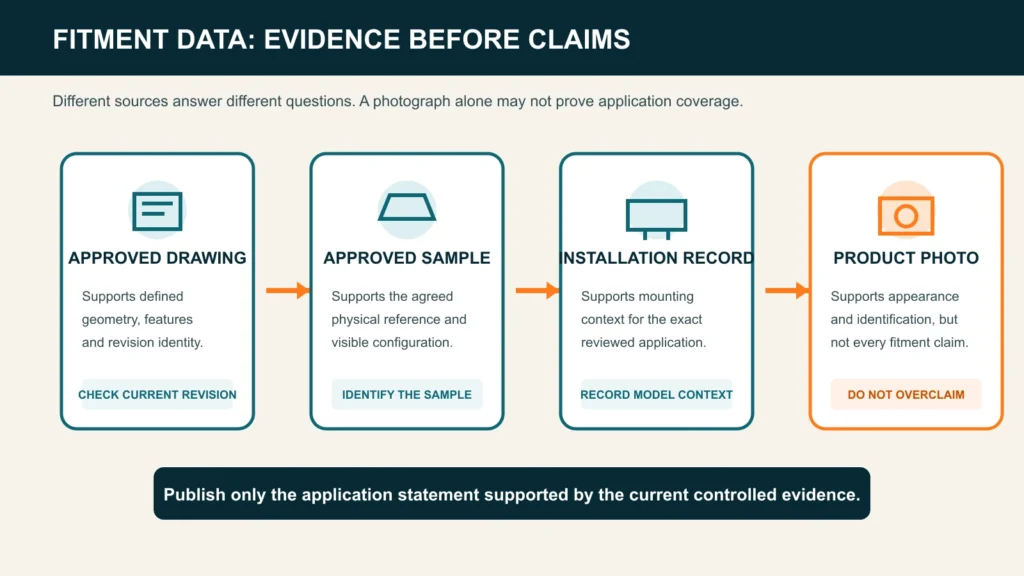
A product photo or familiar model name does not justify a broad “fits all” claim. Keep unsupported applications out of filters, sales sheets and marketplace feeds until the relevant product reference has been reviewed. The motorcycle crash bar fitment guide and rear rack fitment guide explain why model version, mounting points and installation context can matter. Catalog control preserves the result of that review; it does not replace it.
Separate Product Facts From Marketing Copy
A useful catalog distinguishes controlled facts from promotional language. Product identity, application, configuration and supplied items should be verifiable. Descriptive copy can explain the product, but it should not quietly expand the approved model range, performance or package scope.
| Data block | What to record | Why it matters | Do not assume |
|---|---|---|---|
| Product identity | SKU, product reference, side or kit status, current version | Identifies the saleable item | The website title identifies the approved version |
| Application | Make, model, confirmed year or market notes, evidence status | Controls the fitment statement | One model name covers every version |
| Configuration | Visible structure, finish and defined brackets | Separates similar-looking variants | One photograph shows every relevant difference |
| Kit and packaging | Included hardware, quantities, labels and pack configuration | Supports ordering and receiving | Hardware is included unless listed |
| Evidence and status | Drawing, sample or photo reference and release status | Shows whether the listing is reviewable | An old email is a permanent approval |
The fields do not need to be identical for every category. A simple rear rack and a multi-part private-label range may require different detail. Use the smallest controlled data set that can prevent a sales, purchasing or receiving error.
Specify Kit Contents, Hardware and Supplied Items
A listing for a kit should state what is included. Identify the main part, brackets, left/right components, hardware bag and other supplied items at the level needed by the buyer’s sales and warehouse processes. If hardware is optional or sourced separately, the catalog should not imply that it is included.
Branding, labels and packaging may also create separate saleable versions. Keep those approved commercial elements connected to the correct product record. For projects involving private-label presentation, use the OEM motorcycle parts branding requirements as a separate approval checklist rather than treating catalog copy as label or artwork approval.
Use Images, Drawings and Samples as Catalog Evidence
Different references answer different questions. A current drawing can define features and revision identity. An approved sample can support the agreed physical configuration. A documented installation review can support an application statement for the exact context reviewed. A product photo can show appearance and help identification, but may not prove model year, market version, mounting clearance or complete hardware scope.
The Auto Care Association describes PIES as an industry-maintained method for exchanging standardized product information. It is a useful example of why structured attributes, classifications and digital assets matter, but it is not a universal requirement and this article does not claim that XCMOTOPARTS or a specific buyer uses it. See the official PIES overview for that industry context.
Decide What to Do When a Data Field Is Unverified
Give every application record a visible status:
- Ready for release: product identity, application and supplied scope match the current supporting reference.
- Needs clarification: useful information exists, but one or more claims cannot yet be supported.
- Not approved for publication: the product, application or version reference is missing, contradictory or still under review.
These are editorial workflow labels, not certifications or universal industry categories. Their value is preventing incomplete motorcycle parts product data from being mistaken for a confirmed commercial listing.
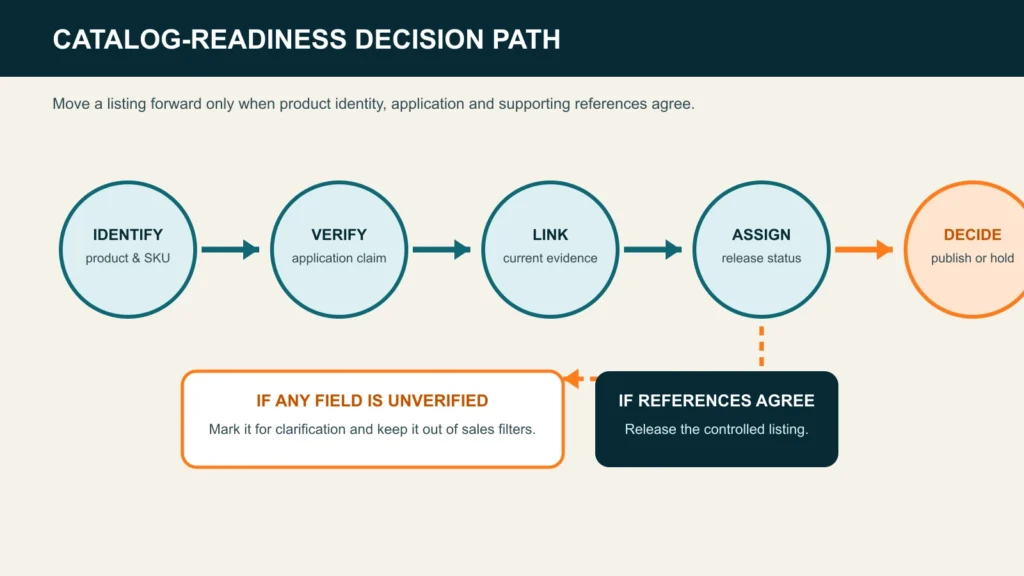
Catalog-Readiness Decision Path
- Identify the saleable product and its current SKU or reference.
- Review the application record separately from marketing copy.
- Connect product, application, hardware and package scope to supporting evidence.
- Assign a release, clarification or hold status.
- If a change affects fitment, configuration, labels, hardware or stock separation, assign an approval owner.
- Publish only statements supported by the current controlled record.
- Keep unclear applications out of sales filters until the missing information is reviewed.
Catalog data should also remain connected to ordering and after-sales records. Motorcycle parts traceability can link an order, revision, batch, carton and record for later review, but it does not by itself prove that a catalog fitment statement is correct.
Frequently Asked Questions
What catalog data should a distributor request before listing a model-specific motorcycle part?
Request a controlled product reference, application details, current configuration, kit contents, supporting images or approved references, and the status of any unresolved field.
Can a product photo confirm motorcycle fitment?
No. A photo can support identification or comparison, but may not show model year, market version, mounting points, hardware scope or approval status.
Can one catalog listing cover more than one model year or market version?
Only when the distributor has a current reference supporting that combined application statement. Otherwise, keep the applications separate or mark them for clarification.
What should a motorcycle parts kit listing identify?
Identify the main component, side or pair status, brackets, hardware and any other supplied items needed to distinguish the saleable kit.
Is a catalog description the same as an approved drawing or sample?
No. The catalog describes the saleable item; the approved drawing or sample is a separate technical or physical reference that may support the description.
What should a distributor do when a catalog field has not been verified?
Mark it for clarification and keep it out of public filters or compatibility claims until the responsible party reviews the supporting reference.
Send Your Product Data for Review
Before adding a model-specific part to a distributor catalog, gather the current product reference, target application list, supplied configuration and open questions in one reviewable file. If you are preparing a new product, repeat order or catalog update, send the available drawings, product photos, model details and data requirements through the XCMOTOPARTS quote contact page. The review can then separate what is supported from what still needs confirmation.